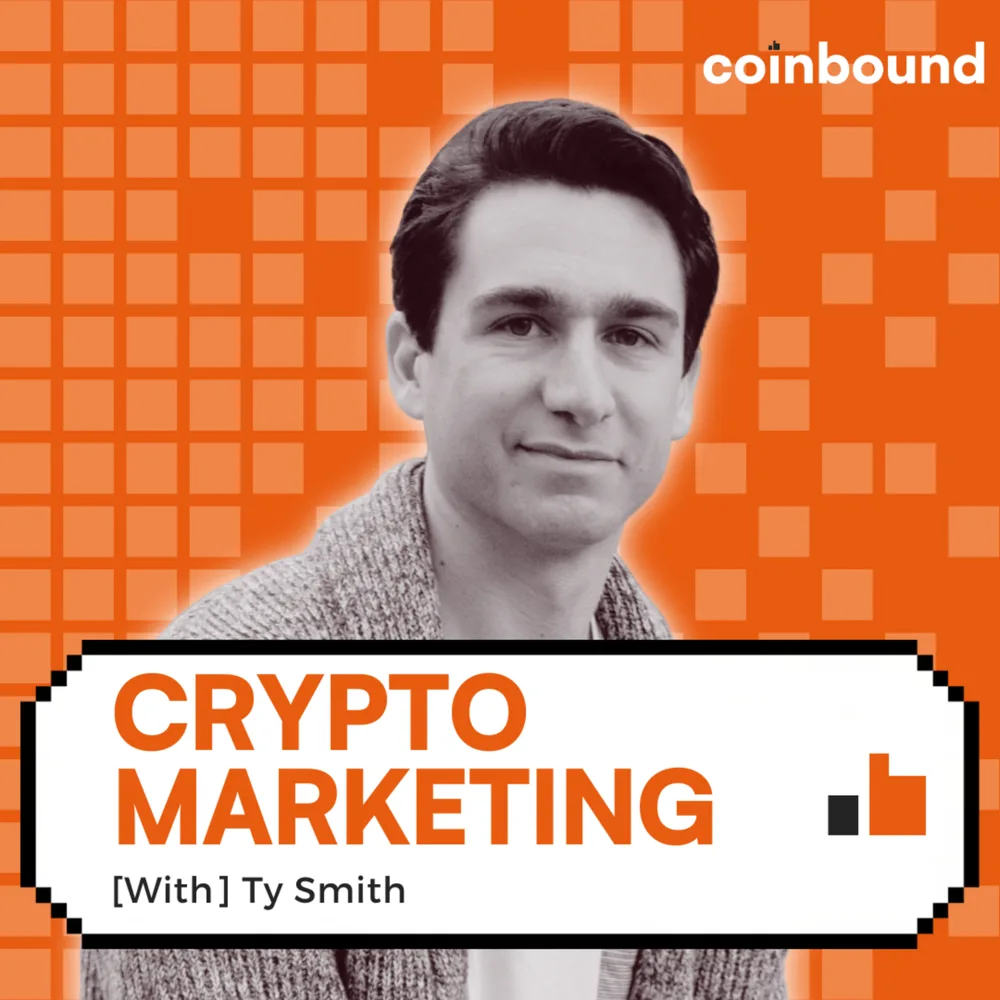
Crypto Marketing with Ty Smith
Episode 2: Content Marketing in Crypto with Aaron Mangal
About this episode
In episode two of Coinbound's podcast, Ty Smith talks with Aaron Mangal about content marketing and how it applies to crypto. Aaron traces his path from running a College Hunks Hauling Junk franchise in North Carolina, to discovering Bitcoin in 2013 through the Triangle Bitcoin Meetup, to working in IT and eventually blockchain full time. He frames content marketing as educational marketing at its core, drawing a line back to old direct mail ads that offered free courses to get people interested in a product.
The conversation digs into where content marketing overlaps with advertising and copywriting, using golf clubs and buying guides as examples, then turns to why crypto marketing is mostly business-to-business since companies and governments need blockchains more than individual consumers do. Aaron and Ty debate this point, bringing up products like Ledger's hardware wallet as a counterexample of crypto's B2C side. They also cover Red Bull's approach to building an in-house media arm, why platforms like Amazon and Binance Academy are investing heavily in user education, and why owning your email list and blog matters more than chasing reach on rented platforms like Facebook or Instagram.
They close with practical tool recommendations, including Mailchimp for email list management and Neil Patel's UberSuggest for free keyword research, along with a reminder that even experienced marketers are constantly adjusting to platform and algorithm changes.
Key takeaways
- Treat content marketing as educational marketing: teach your audience something useful before asking for a sale.
- Recognize that most blockchain marketing is B2B, aimed at companies and governments, even though B2C products like hardware wallets exist within crypto.
- Write timeless, in-depth blog posts (like a solid "what is" explainer) that stay relevant for years instead of chasing short-term trends.
- Invest in video content since it tends to get higher engagement and share potential than blog posts alone.
- Build your own email list and blog rather than relying only on Facebook, Instagram, or YouTube, since platform reach and algorithms can change overnight.
- Use simple tools like Mailchimp to manage your list and UberSuggest or BuzzSumo to research keywords and see what content is already performing well.
- Remember that even experienced marketers are constantly learning and adjusting as platforms change, so don't be discouraged by not having it all figured out.
Questions this episode answers
What is content marketing, in simple terms?
Aaron Mangal defines it as educational marketing: putting out information that teaches your audience something, rather than directly selling to them. He traces it back to old direct mail ads, like magazine offers for a free golf course, which existed long before the term "content marketing" was coined.
Is crypto marketing B2B or B2C?
Aaron argues most blockchain marketing is B2B because companies, governments, and enterprises need blockchains, not individual consumers. Ty pushes back with examples like Ledger's hardware wallets, noting crypto has a real B2C layer beyond the core blockchain technology.
How is copywriting different from content marketing?
Copywriting is about driving a specific action or sale and has historically leaned toward advertising. Content marketing and educational content build trust over time by teaching the audience something valuable first, which brings people back later.
Which content channels work best: blogs, video, or social media?
Aaron favors writing timeless, in-depth "what is" style blog posts that stay relevant for years, alongside a growing push into video since it tends to get higher engagement. He stresses building your own email list and blog so you are not fully dependent on platforms like Facebook or YouTube if algorithms or reach change.
What marketing tools does Aaron Mangal recommend?
He recommends Mailchimp for basic email list management, since many businesses chase social media before getting their list in order. He also mentions Neil Patel's UberSuggest as a free alternative to tools like BuzzSumo for researching keywords and content performance.
Full transcriptShow
Ty Smith0:04
Hello everyone, thank you for joining us for episode two of Coinbound, where we will be discussing marketing in the cryptocurrency industry. Today we're going to focus specifically on content marketing. We have Aaron Mangal going to run us through what content marketing is and how he uses it. He's been involved in crypto for a while now, and he's worked on some really interesting and big projects. So, he'll tell us a little bit about content marketing and how that ties into crypto. Before we get started, a quick little update: Coinbound is now on five podcast platforms. We're on Anchor, Google Podcasts, Spotify, Breaker, and RadioPublic. So, depending on what's most convenient for you, check us out on those.
Ty Smith0:31
All right, Aaron, thank you for joining us. Before we get started, why don't you tell us a little bit about who you are, what you've worked on, what you're about. Go for it.
Aaron Mangal1:01
Sure, thanks for having me. My background is in, I went to college and did business management with a marketing concentration. That was at NC State out in Raleigh, North Carolina. Grew up on the East Coast, so that was where I kicked off my business career. I really did lean into business development, which culminated into like 11, at this point, 11 plus years of business development experience, business development manager type roles. So, I was a part of College Hunks Hauling Junk, which is a junk removal franchise. They started the Raleigh location. It was among maybe the first 10 or 12 franchises to be launched.
Aaron Mangal1:24
And I got to see, it's a very, it's a much more traditional business model compared to digital. You're doing more traditional, you're buying trucks, you're setting up an office, you're buying marketing collateral, physical signs that we would put around town and stuff. So, I think seeing that type of activity right out of the gates of school, even though I didn't really, I still always was leaning into blogging and social media, and I always brought that into any company I was with.
Aaron Mangal2:08
But it's funny how, yeah, we had a franchise manual, like operations manual. So, that I think really grounded me in business knowledge and business process. So, as time went on and I really realized, wow, I really enjoy marketing, I'm passionate about it, I had a great base because I wasn't coming at marketing from sort of a siloed perspective. I understood being sort of the guy in charge. And so, with the College Hunks Hauling Junk thing, I eventually, I was hired on as the first employee, and it got to a point where I eventually was running the trucks and managing the freaking franchise, and kind of took over my life, to be honest with you, and I didn't own it.
Aaron Mangal2:30
So, that was very weird. But you go to like Jimmy John's or Quiznos or Subway, and these are very processized businesses, and I actually think that it served me really well, even though those businesses can kind of be a grind and have a pretty, not so great ceiling because how much are you going to really make in one of those franchises? They're very expensive to run, and no one's, I think, getting crazy rich on as a franchisee, at least, right? So, but it was nonetheless very good to teach about process and turning a business into a process. And I think getting that franchise given to the owner and myself as someone who was implementing the steps in the franchise was a great experience and way to start a business career and eventually marketing because I'm always going to be grounded in that knowledge of what does a real business look like and feel like.
Ty Smith3:25
Yeah, sure. So, obviously this podcast is focused on crypto, marketing in crypto. So, what eventually brought you into cryptocurrency and that whole industry?
Aaron Mangal3:33
Yeah, for sure. So, like I had mentioned, I was in North Carolina. So, I had discovered Bitcoin around 2013, around there, and I was barely dabbling and mining, and it was really hard and just really terrible, honestly. It was just really difficult, and it just felt like you weren't doing the right thing. Like now it's like, of course, it's so obvious, why wouldn't you have done it? But back then, I can really remember the feeling of it wasn't obvious, and it had that quieter feel to it. And it actually, at the time, it might seem like that's so cool to be a part of this stuff early, but I would argue it was so much harder. It was like every year that it was less known, it was exponentially harder because there was sort of less of a social support around it.
Aaron Mangal4:27
Anyway, I ended up leaning into the Triangle Bitcoin Meetup. So, that was actually a really big, important hub for getting started. And I don't care how digital we get, these meetups are so important. And I have gone back and forth with events because I feel like I'll kind of go through cycles where I'm like an event junkie going to billions of events, it feels like, and then I'm going to none. So, but I can say, even reflecting here, I can say that that meetup was really, really important because it gave me sort of a decentralized community, if you will, but still a community to just tap into and start learning about the community. And we met in a, it was so funny, no joke, we were in a Panera Bread where we would have our meetings and be like 30 of us in a corner. We eventually got ourselves into sort of a...
Ty Smith5:22
Love it.
Aaron Mangal5:23
Yeah, it was super random. And it was, again, Raleigh, North Carolina, so it's not like it's a humongous, crazy tech hub. I mean, there is Raleigh Research Triangle Park, but yeah, it was a very tight-knit, smaller community. But we eventually got into this place called the Underground, which is sort of a co-working space, which is not very common over there. So, this was like one of a handful. So, we eventually got the group in there, and that was a really great sort of synergy. But yeah, that was sort of where I really kicked things off. And then I eventually decided to come out West because, like I said, out East, it's a little bit more limited unless you're maybe in like a New York or something. So, I really just was like, hey, let's come out West. And I ended up in SoCal, in LA. And since then, I've just been floating around different conferences, and I had been working in IT, and then eventually made the leap into blockchain. And so, that's kind of the last, I'd say, two to three years have been a lot more hardcore, jumping into crypto in particular, to come back to your original question. So, yeah, that's kind of a long answer to your...
Ty Smith6:27
I mean, we met at, what was it, Crypto Invest Summit, I think it was. Yeah, we had a mutual interest in marketing, so I'm glad we got to talking and now we're doing this.
Ty Smith6:33
When we first met up, we discussed sort of our backgrounds in marketing because marketing is a huge industry. When people say, sometimes people send me an email, 'Hey, you should probably know about this new marketing company because they could be a competitor,' and then I look into them, I'm like, 'All right, they're doing something entirely different.' Marketing is huge. There's so many capacities to it. When I spoke to you, you mentioned content marketing, which is something I want to talk about. I'd really like to be the focus of this podcast episode because not a lot of people know what content marketing is, and it's really a potentially powerful thing. So, in your own words, what do you think content marketing really is? What's an example of it? Just enlighten us.
Aaron Mangal7:26
For sure. Well, it's funny because a lot of people might remember the direct mail order era, and you'd open a magazine and it would say, 'Hey, get your free golf course or free golf lessons course, just call this 800 number and we'll mail it to you right away.' And why would you opt into that sort of golf course from a magazine? Well, you're opting in because you want to learn something, and it's like, 'Oh, free course, fantastic.' So, it's kind of funny because everyone, when you go out there on the web, it might almost seem a little annoying at this point, right? Like everyone's got their funnel and their course and their how to become a millionaire, right? But it's really truly rooted in education.
Aaron Mangal8:18
And so, educational marketing and direct response marketing, to be specific, have been around for a long time. In fact, that was to me a much more, before we had mass media, before we had radio and TV, it actually was normal to do content marketing. Mail order, in my opinion, and we can look at the ads to see evidence of that, was very much oriented around content marketing. So, to answer your question, content marketing to me is educational marketing, to keep a simpler definition.
Aaron Mangal9:06
So, when we say content marketing, we're really talking about educating the audience. People have also thrown this term around, brand journalism. There's always some, I like the marketing eating our own dog food within marketing, there's all these crazy terms. It's like, 'Oh, let's re-market marketing, right?' So, in a way, part of me just feels like, what if content marketing is just educational marketing and direct response marketing rebranded under a new term that is new and everyone understands? I do think there's more to it than that because digital has brought the means of production to everyone. Everyone can have a YouTube, a podcast, a blog, if they know how to use the tools, of course.
Aaron Mangal9:31
But yeah, I would say content marketing is educating your audience through your information you're putting out around your company. Back to the golf example, let's say we didn't even have radio, we didn't have TV. So, I want you to buy my golf training. Well, I'm going to advertise to you in a magazine, a golf magazine, and say, 'Call us at 1-800-FREE-GOLF to get your free golf course.' You see what I mean? So, we can see the history of content marketing long ago, well before this term was even coined. So, I don't know, that's a long answer again, but that's how I do it.
Ty Smith10:18
No, it's perfect. Yeah. So, an example of content marketing that I always think of, and tell me if this in your opinion is content marketing because the definition does vary a little bit depending on who you ask. But I think of creating blog posts, for example. Maybe you're interested, let's go with your example of the golf course. I want to look at golf clubs and find out what the best golf club is of this year, of 2019. So, I go into Google or whatever search I use and look up 'top golf clubs of 2019.' And people, I think sometimes people don't realize that those things are written by people marketing to you. They're not spending that time analyzing all these golf clubs just because they're into golf. There's a reason. And if you click on those links, they're to sell someone's golf clubs who are writing that. So, is that content marketing in your opinion?
Aaron Mangal11:14
I think so. I mean, if you wrote like a golf club's buying guide, that might be encroaching into sort of the advertising catalog arena, if we want to split hairs here, which of course we are, that's the point of talking about it. But I would say it's kind of a, like I said, if we're going to split hairs, I would almost say it's leaning a little bit into advertising because that's kind of catalog-like. And I think Sears, was it Sears or it was like Lord & Taylor, Claude Hopkins is a pretty legendary copywriter, and if I'm not mistaken, I think William Lord, so the Lord person from Lord & Taylor, hired Claude Hopkins in like the early 1900s to make him a catalog, and he paid him like a million dollars, which must have been a crazy amount back then.
Aaron Mangal12:08
But what I'm getting at is like, I think content marketing and advertising, there is probably some crossover. And I would say it is still content marketing to me, but there's definitely a solid amount of crossover into advertising, which is I think the point of sort of catalogs. Catalogs were almost like, 'Oh, let's showcase products in a methodical way in front of people,' you know what I mean? And so, a buying guide, for example, I would say it's like a cross of both because, and the reason I say a cross of both is because you're still kind of encouraging people to buy, or like, 'Which club should I buy?' Whereas pure content marketing might be something like how to improve your golf swing or how to improve your putting, your short game, your yard game, or how to avoid sand traps. That to me would be pure content marketing, not advertising, but it would still be trying to lead you to the same place, which is to buy eventually.
Aaron Mangal12:39
So, maybe your how to improve your short game would lead you to golf club buying guide because I was thinking about my short game, now I'm thinking about buying a club. 'Oh, yeah, let me check out this buying guide because I am kind of interested in buying a club.' But I think that to get, like you said, we'll get into it more, but I think there's something to be said about where are they in the buyer's journey, as they say, and different content might apply to different parts of that buyer's journey. So, like I said, there is the crossover, but it's also like where they are in the process. So, you're just kind of driving them to your site, like you said, just kind of like read up about golf, maybe not even advertising-focused, but eventually you want them to find that buying guide, which might eventually have a coupon code, which hopefully will lead to a sale, right?
Ty Smith13:33
Yeah, exactly. So, content marketing, specifically for crypto, how is content marketing unique in crypto compared to other industries? Is there anything about crypto that needs to be taken into account when you're doing content marketing?
Aaron Mangal14:05
Yeah, it's a funny, it's a good question. I think, if you really think about what is crypto, it's this crazy amalgamation of FinTech and SaaS and databases and engineering and basically enterprise IT. Blockchains are enterprise IT. IBM is selling servers for 100 grand with blockchains on them, you know what I mean? And so, if you really think about it, it's just like multiple industries being spliced together.
Aaron Mangal14:28
So, to answer your question, absolutely there should be things kept in mind, namely that we're dealing with B2B. It's almost like people don't realize this is a business-to-business construct. Are you going to seriously go on the street and be like, 'Hey, man, you want a blockchain?' No. No one needs a blockchain. Companies will need blockchains, governments will need blockchains, enterprises will need blockchains, non-profits will need blockchains, any kind of entity organization, they will probably need blockchains. I don't see B2C, that type of marketing, like selling fitness products or supplements or, I'm just trying to think of some common B2C products, like beer and wine or food. I don't see blockchain being marketed that way, or it really shouldn't.
Ty Smith15:20
Well, I think it depends on what it is. It depends on your involvement in crypto. For example, Ledger might do some kind of, they have, they're B2C. They have a hardware wallet. They have a physical product that you go online and you buy. You might be reading an article, 'top hardware wallets,' and that either might be written by Ledger or someone affiliated with Ledger. So, there's definitely, in my opinion, you mentioned how it's mostly B2B, but there definitely is a B2C component in my experience. There's much more to crypto than the actual blockchain. There's tech services, and there's a whole industry that's growing right now at a really, really fast pace that will need marketing, and in that marketing plan will be content marketing.
Aaron Mangal16:12
Yeah, totally. I think that I'm making a guess here. My guess would be that the B2C component of blockchain will be very, very small compared to the, what I see as a, it's kind of like the tip of the iceberg. There's going to be so much going on behind the scenes, like for us to cash out over here or cash out over there or move this here. I think there's going to be a lot of auxiliary services going on. So, that's why I lean, I just think, and again, if we're talking like where is the majority of the activity and arguably marketing spend going, my guess would be a bigger component towards B2B. But I think you're right. There is a B2C component from the standpoint of, well, this thing is also meant to be an alternative to traditional centralized banking systems. So, you're right in that sense.
Aaron Mangal17:04
But it is going to be interesting for sure because it's like, do you consider Gmail B2C? I mean, yeah, totally, right? But at the same time, there's probably a lot of other stuff behind it that is like crazy, like cloud partnerships that we probably have no idea about. I mean, I worked in IT briefly, and it's like you go to these events and you're like, 'Wow, there's like 19 different ways that Amazon and Google hook up to each other through really weird cloud and SaaS products that we've never heard of.' So, that's part of why I feel like, I'm just thinking again, I'm also thinking long-term here, and I just wonder if, to your point, but is Ledger just going to end up in Best Buy? And instead of it being B2C, it might just end up in big-box stores. I don't know, I'm just asking the question, even though I know it's your show, but you do wonder these things, right? It's like, what's going to happen? I don't even know, but it's fun to discuss for sure.
Ty Smith18:05
Yeah, no one knows. My point of bringing up Ledger is that there's a lot more to crypto than blockchain. Blockchain is the center component of crypto and cryptography and cryptocurrencies, but the industry, the whole industry is massive, and there's all different kinds of businesses in crypto. I mean, for example, think of this podcast. This is a crypto industry marketing podcast. There's hundreds of, probably thousands of podcasts out there about marketing, about different kinds of marketing, about SEO marketing, about content marketing, about digital marketing, about physical marketing. But that's not what we're talking about. We're talking about crypto marketing because that is a whole different industry. So, we can go on and on about that for years. Let's go on to the next thing, which is who really can benefit from content marketing the most?
Aaron Mangal18:40
I would say anyone that needs to educate their audience in a deeper way. If you look at back to our B2C discussion, a lot of those products are kind of like, 'Buy our green drink or green powder because we've studied this for like 19 years and we put it through our lab and we learned all this stuff, it's really great.' To me, a lot of the stuff around blockchain is a lot more complicated. And so, I think that enterprise-focused concepts need more education to the customer base.
Ty Smith19:30
That's actually a really good point. I didn't even think about that. You called it education marketing, and crypto and blockchain is definitely something that, I mean, what percentage of the world do you think even understands what a blockchain is? It's single digits for sure, maybe even a decimal point.
Aaron Mangal20:05
Exactly. And there's something to be said about, what is the, like for example, I don't know if you remember when Gmail first came out, they did the whole like, everyone gets 50, or not everyone, a few people get 50 invites, and they started sharing those invites around. And I remember that there was kind of this controlled network effect, if you will, because they sort of released it methodically, right? So, I feel like it's going to be really interesting to see if crypto's the same way. Is it going to be like that where we kind of have to push really, really hard in the beginning to just get that network effect, and then as time goes on, it'll become more like, first it's like get them to jump on board, and then the rest of the time is teaching them how to use it? So, that's just to throw another wrench in our discussion here. But you know what I mean? It's like content marketing, like advertising might be a better solution to just drive people in the door initially, but then as time goes on, nurturing that use of your product, in my opinion, when you talk about apps, you need that ongoing sort of education.
Aaron Mangal20:41
And I don't know what you've observed, but it seems to me like a lot of the types that are hardcore programmers or engineers, they don't always gravitate towards this kind of stuff we're talking about that maybe comes naturally to us, like, 'Oh, we should be educating our client base or users.' A lot of the time for them, they've just kind of been trying to piece this thing together. So, I think it's really needed to just keep people using it and using it more. And it almost comes to a point where you just kind of want to, like an app, for example, how many ways can you use that app? Or, you know, it's kind of an interesting thing, like what you're talking about because I think there's so many ways to do it. But I think the crux of the matter is getting people to keep using your stuff, right? Because eventually, if they don't, maybe they'll go to a competitor or something better eventually. Like I'm sure Amazon every day thinks about, 'How do we keep people here and never let them leave?' And they seem to be holding on pretty darn well to keeping us in there, almost to my annoyance at times. But they've built heck of a freaking machine, and there's so much value they're providing that it's kind of hard to justify other options, right?
Aaron Mangal21:41
So, just to kind of, and just to go on to the Amazon example a little bit, see, Amazon almost really turns them all on its head because I don't know if you've ever opened up Amazon Seller's account, I've done a little bit of e-commerce stuff, e-commerce, and it is insane all the information and knowledge and, frankly, education they give you. You open up a seller's account, you could probably spend like three hours on tutorials and training that Amazon put out for users on how to use their platform. So, that's, again, I'm kind of jumping around here a bunch, but I think that's what's going to start happening. Platforms are going to actually build in education. Look at Binance Academy or whatever. Like, they're going to start building in content, and I see it at companies that seem to have achieved a certain degree of growth. It's like, well, now you have all these people here, what are you going to tell them? I think the answer to that is content marketing is going to be one of those things you tell them, which might not be considered content marketing, might just be considered content. But I think between us and our discussion here, it absolutely is marketing, right? Back to our golf discussion, 'Oh, yeah, I need to improve my short game. Oh, yeah, I'll check out this buyer's guide. Oh, yeah, I'm going to make a purchase,' right? I think that's the kind of processes we think about in our work. So, yeah, man.
Ty Smith22:41
Yeah, so earlier you mentioned that content marketing can look like a lot of different things. There's so many channels. There's YouTube, there's podcasts, there's blogs, there's endless channels you can reach out and touch the world with. What do you, in your experience, find to be the most worthwhile in terms of the amount of time it takes to produce and money investment, things like that?
Aaron Mangal23:29
Oh, man, that's a, that's a tough one. But it's a good, hard question to ask. I would say, it's funny because I feel like at times I feel like I'm stuck in internet marketing from like the year 2000 or 2007.
Ty Smith24:17
How so?
Aaron Mangal24:18
Well, there was this whole world of, it was like everyone had a long-form sales page, and it just seemed like everyone was playing that same game. Like you had Frank Kern and Rich Schefren and Jay Abraham and, who else did we have back then, Alex Mandossian, teleseminarians, anyone remember that? I love that. I love that era. That was such a fun era of just absolute excessive everyone hanging out a shingle for different kinds of marketing. So, what I'm trying to say to you is I feel like I'm kind of in this word land, and I've started to realize as rich media has really evolved since that time, it's been like 10 to 12, 10 at least 10 plus years since I was kind of diving in deep to a lot of marketing, and that's where I think my direct response content marketing sort of deep programming comes from because I just realized, wow, look at all this movement people are doing. But I think as the web changed and algorithms changed, it became kind of this like, 'Oh, like I'm going to do this so that I am first page on Google.' But I actually believe educational marketing and content marketing worked the whole time, but I think everyone was trying to find these shortcuts to like hack that first page of Google, right?
Ty Smith25:27
Yeah, well, it's funny. I actually wanted to bring up SEO. SEO, for people that are listening and don't know what that stands for, it's search engine optimization. It's getting your page, your website in the top page or top five results of Google. And it is, potentially is very closely tied to content marketing. Some might consider it a separate thing, but some might consider it even part of content marketing. What is your experience with SEO? Do you spend much time on that, or do you not consider that part of content marketing?
Aaron Mangal26:11
Yeah, well, I think this ties in with your original question you were asking, which is sort of like, what's the sort of craft and what's the trick, right? So, again, I wasn't going to let you go, by the way, without answering that. No, I know, right? So, that's why I think it was really about copywriting for me for a long time, like really understand those words and really understand like how, and again, driving your, it's like persuasive content, study is kind of what copywriting is to me. But then...
Ty Smith26:38
Well, before you go even further, and I feel like we're going off into so many different branches of this conversation, but it's really a helpful and informative conversation, so I guess it's kind of necessary. Copywriting, how would you differentiate that from content writing? Is it part of content writing, or is it a separate thing?
Aaron Mangal27:07
I think it's definitely a part of content writing, and this is where you get that weird like brand journalism crossover because, on the one hand, copywriting historically has been more about getting you the sale, for sure. And that's why I think copywriting has been historically more maybe advertising-leaning. Remember how I said it's kind of like the Venn diagram? Although there's parts of copywriting that cross into sort of a non-direct sale approach, like for example, the free golf course. I might actually be employing copywriting tactics to get you to opt into that free lesson. So, even though I'm not necessarily trying to get you a sale, I am trying to get your attention to a particular action. So, copywriting I think is very much around driving action and driving behavior and driving, yeah, driving people to do something, right?
Aaron Mangal27:33
The content marketing and education piece to me is more of a, 'I'm going to teach you something upfront, maybe even for free, and because I'm doing that, it's building trust,' which is a really easy thing to miss in marketing because everyone's just like hanging out their shingle and shilling away. But I think when you really build trust with your audience, and like let's say you get them results upfront, like let's say you give away some insane, great knowledge and they're just like, 'That was crazy valuable.' Well, guess what? Now they're going to come back to you and say, 'What else does he have or she?' And so, I think it's all, it's a trust-building exercise as well. A lot of these concepts don't exist in a vacuum. There are people involved, right? So, I could like convince someone to do something once, but maybe if they didn't like the product or the product was bad or our service was bad, they might go away eventually. So, I do think the copywriting is like, okay, I could hook you in, but I think the content marketing and the educational marketing is what keeps you there because I'm like feeding into your interests. That's where I think a lot of this is very journalism-oriented.
Aaron Mangal28:35
And I don't know if a lot of journalists have woken up to this, that, hey, writing from a journalistic perspective in a marketing context is actually really awesome because you're kind of simulating that process of someone reading an article, but you control the medium, so to speak. Like DigitalMarketer, I'm a big fan of their work. They were talking about how, I mean, when you say content marketing, we're really talking about publishing, right? Like, have you ever heard about how Red Bull is not a energy drink company, they're a media company? That's kind of why. Who's saying that? Who's saying that? Well, there's Red Bull Media. And so, they actually have a media arm. They literally have a media arm, and they, if you look at all these like events that they'll put together, like surfing and, I heard that on a presentation, I can't remember exactly which presentation it was, but if you look at their, the way they're structuring their business, there is literally Red Bull Media.
Aaron Mangal29:30
So, if you look at the way Red Bull's approaching it, they're actually building a media arm around their brand such that Red Bull Media is its own entity. It's freaking nuts. It's like, wow. It's probably smart. It's got to be smart. I mean, I don't know, I'm not an energy drink guy, but I imagine it's not as booming as it once was because people have a little more education around it and it's not the most healthy thing. But yeah, I mean, I'm into surfing and extreme sports and all that stuff, and I see Red Bull everywhere. They definitely are an incredibly capable marketing and media company.
Aaron Mangal30:20
Yeah, and if I decide as Red Bull, 'Hey, what if I just like invest an insane amount of resources into like having like RedBull.tv and then I get the rights to like stream that open, the US Open surfing tournament?' Like, that is brilliant. And you know what? It almost scares me how aggressive they are with their media because it's like, my god, if you were like energy drink competitor number two, how would you even get in the door? You know, it'd be like, oh my god, because they literally are like dominating the entire event. And to your point, as a result, the positioning of their brand. And so, I don't know, man, it's like, wow, if you really learn those publishing tools, as you say, obviously Red Bull's doing it on a whole another level, that is pretty interesting. Like, it's almost like you can become your own media outlet if you're, you know, if you can tap into people's interests enough, and like if they respond by watching, well, you got something there, right?
Ty Smith31:21
Yeah, absolutely. So, something, I go to a lot of these events, as you know, as you do also. And when I'm talking to people involved in the industry, there's this general consensus that, you know, the tech is, it's not fully there, but it's, it's already at a point where it is dramatically capable of changing the world. But it can't do that until people really, like till the average Joe knows how to use it and knows, what it's capable of and, and how he can interact with a blockchain without losing his money and things like that. And I, I'm glad we're, I'm glad you drew the comparison between content marketing and education marketing because I think that's a huge piece of, of crypto that's, that's kind of missing.
Ty Smith32:14
People are focused on just raising awareness around Bitcoin and Ethereum and, and things like that, but not a lot of people are out there, you know, really explaining how to use it, explaining how it works. And I am very much looking forward to people, you know, start doing that because it's almost a noble venture because you're not necessarily going to be, you know, monetizing, promoting Bitcoin or things like that unless you own a, you know, a massive amount of whatever it is that you're promoting. But yeah, actually, I wanted to thank you for, for connecting that there.
Aaron Mangal32:34
Yeah, totally. And really quick, just while we're on random sort of musings of marketing, there was like, I think this is something really fun we could maybe as time goes on, we could like break down like ads and stuff like that. But I, I love going to old-school ads, and like there's a certain, there's a certain energy and intelligence in them. So, I think this was from Claude Hopkins, if I'm not mistaken. But it was for Schlitz Beer, and in the ad, he was talking about how they made the freaking beer. And I was like, that is a trip, man. He literally was like, 'We like steam like sterilize the the bottles, and we like do this, and we brew the beer like this and that.' And it's like the ad totally comes to life, and it's like he's kind of educating you, though. It's almost like he's like, you know, giving you kind of a like a little like, 'Here's what it looks like when we make beer.' He did it through words. That's why I really love old-school copywriters because they just brought ideas and concepts and words to life.
Aaron Mangal33:32
And I just think that it's so awesome when you can do that. And if you can combine like content marketing in quotes and advertising, I think that's a magical moment because you're sort of capturing people's imagination, but you're also maybe making the sale, which is probably keeps everyone happy, right? So...
Ty Smith34:10
Exactly. It's funny, funny that you brought up the Schlitz Beer because over the summer I was in Amsterdam where, where Heineken is based. And I went to the Heineken Museum, and I, I'm not a huge beer drinker. I, you know, when I am drinking beer, it's, it's usually something simple like Bud Light or whatever it is, Coors Light. And we went to this, you know, the Heineken Museum, and a huge part of it was, you know, I'm realizing now, content marketing. It was, it was, you know, rooms of people educating how Heineken is made and, you know, the history of it. And, and because of that, it's not to be understated that it does, when done correctly, it does create sort of a relationship between you and the product because I, I was never a Heineken guy. I drink Heineken all the time now because of that, because I, I have been there. I've seen it made. I've seen the, you know, the, the huge machinery making it, and, and it's sort of, you know, I enjoy that trip. I enjoyed going to the museum, and now I enjoy Heineken. You bringing that up kind of put that in my mind.
Aaron Mangal34:39
That really makes you wonder if, seriously, should Maker's Mark just like live stream their freaking like distillery? Because like I, my friend, you know, he had turned 40 and we went to Kentucky and I like literally saw where Maker's Mark was made. And I almost feel like if they had kind of shown me that reality a little bit sooner, I might like exactly to your point, because now when I have Maker's Mark, I'm like, 'I was there.' And so, I know exactly what you're talking about. I think this is actually a great, in a way, breakthrough. Might sound weird to say that, but like this is, what we've just talked about in my opinion is a great reason for people to show what they're doing. I don't care if you're a company, if you're Nike or you could be big, you could be small. Like, there's something to be said about showing people what's going on. And back to my point about brand journalism, I think there's a huge opportunity to kind of do the like Gonzo journalism, like almost like write like from a journalist perspective, even if it's someone within the company because that perspective is very unique. We're not there making the shoes or making the beer or making the product. And so, when you open that like vision to us, I think it kind of does something. I don't know. For you, it sounded like it did, and definitely for me, too. So...
Ty Smith35:32
Yeah, it's almost making me think of all the things that I don't even realize, you know, potentially to get me to to draw a positive relationship with a brand. It's super, super interesting stuff. But again, we went on a pretty long tangent. The original question was, don't forget the original question. All right, so YouTube, blogs, SEO, whatever channels there are for content marketing, what do you, what are you a fan of?
Aaron Mangal36:24
Yeah, i mean, like I said, I've grown up on social media like Facebook and blogging, but I feel like I ignored video for a long time, and I feel like that was to my own like loss, you know what I mean? Not that I have any regrets, but I will say I kind of feel like I wish I had jumped on the video bandwagon a lot earlier. But to that point, I still feel like there's plenty of value to hang out your shingle on a blog because you're creating that long tail. And again, this is another good reason for why you want to create content that can kind of survive a long time, like creating content that's fairly timeless. This is why I love like 'what is' type blog posts. So, when we talk about a blog post, you know, I like to really go hardcore, like in-depth. Like, I remember I wrote a blog post like 'what is cloud computing?' Well, that post, I wrote it like four years ago or three years, no, maybe like at this point maybe three years ago, but like you go read that post and it's still pretty like, 'Yep, that's still cloud computing,' you know? And it's been three years. So, I actually, I actually look at it as write pillar, timeless content on your blog if you're going to do a blog, and you can also use certain tools that I know we're going to maybe dive into here a little bit about finding out what's ranking well, and sort of, you know, you can kind of cherry-pick what's already getting a lot of attention.
Aaron Mangal37:33
The piece that I would say I'm doing more of now and want to keep doing more of would be definitely video because I think video gets a very, a higher participation level than sometimes a blog does. Like, it can be really hard to get a blog to sort of go viral, so to speak, in quotes, but a video has a much higher probability to so-called go viral in quotes. But even if it doesn't go viral, heck, if you get 1,000 people watching it, 5,000, 10,000, that's not too shabby. So, like I said, I've been in social media land, I've been in blog land, but I've also observed the shift in those platforms. I mean, it's kind of scary to think that we could be at the whim of Facebook and Google, and I don't know if you remember, you know, a few years ago when like people started losing their freaking minds about their Facebook reach going down. It actually happened, I think, multiple times because I remember in the early days, they like throttled some kind of reach. I don't know what kind of strings they're pulling behind the scenes.
Aaron Mangal38:45
So, i would sort of caution people against, even though I did it a lot myself, like being too embedded in someone else's platform, as great as the results could be. I always come back to, are you building a list? Are you building content on your own domain, even if maybe the results, you know, might not be as awesome as like Facebook or YouTube? Not to say don't do those things, but I just feel like you always have to kind of keep in the back of your head that this could change, and like, where is your audience? Are they on someone else's platform? Maybe we should think about that, right? So, even beyond just generating the audience is, where is your audience and where, and are they on your domain, your list, right? I always kind of like clobber people over the head about their list because, hey, if you used Facebook in the early days and you just like aggressively built your list, and then the one day they turn off the pipes, you're like, 'That's cool, I got 10,000 people on my email list, it's fine.' You know what I mean? So, I think we have to approach things a little bit holistically and always make sure we're directing them back to our list. So, I actually am of the opinion like even if my results, like compared to maybe some other like, you know, marketer, are not great, but even if we just built a little bit of a list, I'm still like, 'Well, at least we built our list that we'll have for a while,' right? So, so that's, that's another angle to that. But I don't know if I answered your question. I really do feel like I'm jumping around here. Hope you don't mind.
Ty Smith39:45
No, no, I don't, I don't mind at all. It's a, it's a, a topic that we're both passionate about, so naturally that's going to happen.
Aaron Mangal40:14
Yeah, this is like more how we would actually be talking out in the world, not like this sort of rehearsed, perfect thing, which, which I enjoy, so anyway.
Ty Smith40:22
That's fine. That's, that's how we like to do things here at Coinbound.
Aaron Mangal40:31
That's awesome.
Ty Smith40:32
But yeah, another thing to be said about drawing attention to your own platform is analytics. Facebook, you know, if you post on Facebook or YouTube or whatever it is, whatever channel it is, you get some form of analytics usually, but it's, it's typically not enough to, to really customize your content and see what's working. When you own, you know, when you have your own blog, I highly recommend, you know, people come to me all the time for, for marketing consultations, things like that. And one of the first things I always look for is, do you have a blog? Because a lot of them don't. A lot of them don't think it's important. But when you can get people that are interested in your service, you know, they don't even necessarily have to be interested in exactly your service, just something similar. Maybe they Googled something similar and they got a result that, that brought them to you, you can retarget them much more effectively than you could through, any kind of social media platform.
Aaron Mangal41:30
Yeah. And that's a good point about Facebook and it's just the audiences that they're building. So, that's another good point is like, you know, we can use like, to your point, you could use an email list and upload it to Facebook and generate an audience around that list. So, that is another good point, which is, it's not just like one way, like, you know, I feel like Web 2.0 or whatever point-O it was, was like, generate a, like I said, back in the 2007 internet marketing days, it was like, you know, 'Drive people to my list and then sell products, build list, sell products.' Like, that felt like that was very like mid-2000s like internet marketing. But to your point now, it's like Facebook's really changed the game by making it all about a really great experience, and they actually reward, back to our original discussion of content marketing, I feel like they reward good content marketers because if you're, even if you're a brand, but you're getting people engaged with your content, Facebook gives you basically kudos, so to speak, right? And, and you might know a little more about that than me, but just like, they are rewarding brands that are getting good engagement. When was that metric ever out there? Like, where advertisers like, 'We want people to enjoy the ad,' you know? No, that never was the case. Only now with Facebook's sort of, 'We want people to have a good time' mentality has really like just changed the game. I've even heard that a lot of old-school direct response people and copywriters that are used to that old-school advertise to people and use my magical words to manipulate you aren't able to keep up in this new world. So, it's kind of cool like you doing this show and us talking about this. This is new ground to be covered, even though there's awesome people like Claude Hopkins that we can learn a ton from. There's still a lot of new ground to be covered and frontiers, and that's why it is kind of cool that you're bringing this to sort of like crypto and marketing. And I think there's going to be a lot of new, cutting-edge things to come out of like specifically the crypto and blockchain use case of marketing itself. But again, this is like going to be a whole another freaking show, so I don't want to have to open that can of worms.
Ty Smith42:33
Yeah, no, well, we'll definitely bring you back on and, you know, go down all the other rabbit holes we just dug for ourselves. So, one of my last questions is, is in regards to software and, and tools that you use. What is there out there that, that you use that you find helpful?
Aaron Mangal43:38
Yeah, totally. I mean, you know, I don't want to insult anyone's intelligence, but, you know, I think starting with simple like email marketing stuff is really great. Like, you know, I always, I've recommended, you know, Mailchimp to a lot of people just to get started with managing their list because sometimes like people don't have like, you know, they're like, 'Oh, do I have a CRM or this email marketing thing?' And so, like, you know, getting people to like put their list on Mailchimp, and to your point earlier about getting them on a blog, that's a similar sort of like important, fundamental step that I've directed people towards. So, using sort of the Mailchimps of the world or some kind of email marketing management tool or platform is super important. And again, not to insult anyone's intelligence, it sounds so rudimentary, but it's often very missed because people, like think about what, what happens. People start going towards Facebook and, 'Oh, I got to be on Instagram,' and, 'Oh, I got to be on YouTube,' and, 'Oh, I got to be on YouTube.' And, you know, I was talking to some realtors, and I'm like, I asked them about the list stuff, and I see them running over towards, 'Well, we got to keep up on Instagram.' And I, I think it's so interesting because everyone's fighting for like putting the coolest video up on Instagram, but they're not, they're not taking that same amount of effort to like make sure their list is in order and that they have a good, even cadence of emailing that list, right?
Aaron Mangal45:11
So, that's, that's one area I think, and again, that's not exactly a tool per se. As far as, Mailchimp is a tool.
Ty Smith45:14
Yeah, right. Mailchimp, Mailchimp answers my question.
Aaron Mangal45:17
Good, okay. I wasn't sure how, like, I almost feel like I'm like totally overthinking this because I'm like, 'I got to come up with some really amazing tools.' But I like Neil Patel, man. He's like a really cool, like, he's a good marketer, but he also is trying to like upset the cart a little bit where you've got stuff like BuzzSumo where you can like look up a domain and, you know, they, they give you like a little bit of, of that for free where you can see how content performs. But Neil Patel created this other one called UberSuggest, and he's been basically, his whole thing is, is, 'I'm going to take all these competitors that are out there like BuzzSumo, and I'm going to make a free version of that.' So, his, his thing, um, I've tried it a bit, and I don't know I would say it's as good or better than BuzzSumo, but I still think it's really cool that he's putting out a free tool where you could look up keywords for free, and he gives you a decent amount of data. So, you can tell like his sort of world domination plan is, 'Let's get all the marketers, you know, on my platform using my free tools so that I can, of course, market them more stuff,' which I, he absolutely should. But so, those two tools...
Ty Smith46:23
Yeah, he really is kind of the, he really carves a nice little niche for himself. He definitely is all over the place. You can't talk to anyone in the marketing industry who doesn't know who that is.
Aaron Mangal46:29
Yeah, exactly. And you know what else kind of blew my mind, like it made me feel a little bit less like self-loathing about, you know, figuring out marketing, which is, he had like, he was the one even talking about algorithms changing and he's like, 'You know, oh yeah, our YouTube like overnight, you know, crashed,' and like, they're battling the same stuff too. And these, and, and it kind of blows my mind that they're such pros about it because they like, they're also battling the same stuff. So, like when people like, you know, I don't know, I don't know how it is for others listening, but I've always felt like, 'Oh, I'm not good enough, I don't know enough, I...' It doesn't matter. You don't actually have to know enough, be good enough. Why? Because even the pros are doing trial and error and trying new stuff and like waking up the next week and stuff's changed. So, I think it's so important for us to step back and say, 'Hey, it's okay to learn this stuff and they might be hard.' And I think you and I are always learning new stuff and, you know, to kind of be the best that we can for the people that come to us for, for knowledge, right? So, um, that's just, I mean, that's just a random, not, not even like marketing exactly, but just kind of like, give yourself a little break, it's okay, and everyone's learning. That's kind of one thing I realized. I don't care if you're a pro or just starting, like everyone's learning just at different levels, and, you know, certainly I feel like I wish I would learn certain things faster, but it does, it does make me feel good to know that even the pros are figuring stuff out, so.
Ty Smith47:41
All right. Well, before we, before we let you go, how can our listeners find you? What social medias are you on? Do you have a website, anything like that?
Aaron Mangal48:12
Yeah, you can find me on, let's, let's go with Twitter @healingvibes, and you can look me up on LinkedIn, Aaron Mangal, A-A-R-O-N M-A-N-G-A-L. And, yeah, I'll definitely reach out, and I do some podcasting as well in the blockchain space, not, not in the marketing realm, but just kind of like general sort of discussion around it. So, but I, I love this, I love this prompt that you have put together. I actually listened to your intro. I didn't even tell you that I did that, but I really liked what you had to say, and I'm actually kind of excited to learn from others, and as someone that's on the show, I like the platform to share and kind of like, it's kind of weird, like when I was talking about marketing, I'm like, 'Wow, that's so different than the experience of doing marketing,' you know what I mean? It was kind of like meta. So, so I appreciate you opening up this, this, this platform, and I'm looking forward to learning from others, and hopefully coming back one day if I didn't go on too many tangents for you.
Ty Smith48:45
No, absolutely. I mean, all those tangents, you know, we went on them because they're, they're really valid, interesting points. So, I definitely will, you know, we'll get you on and we'll discuss all those things separately, and we'll try to stay on a little more topic next time, maybe.
Aaron Mangal49:16
I know, right? Yeah. But yeah, it's good stuff, man. And I think that, yeah, I'm, like I said, looking forward to it, and again, great content marketing right here.
Ty Smith49:23
All right. Well, thanks a lot. That's, that's all I got for you today. Thanks for joining us.
Aaron Mangal49:26
Thanks for having me.