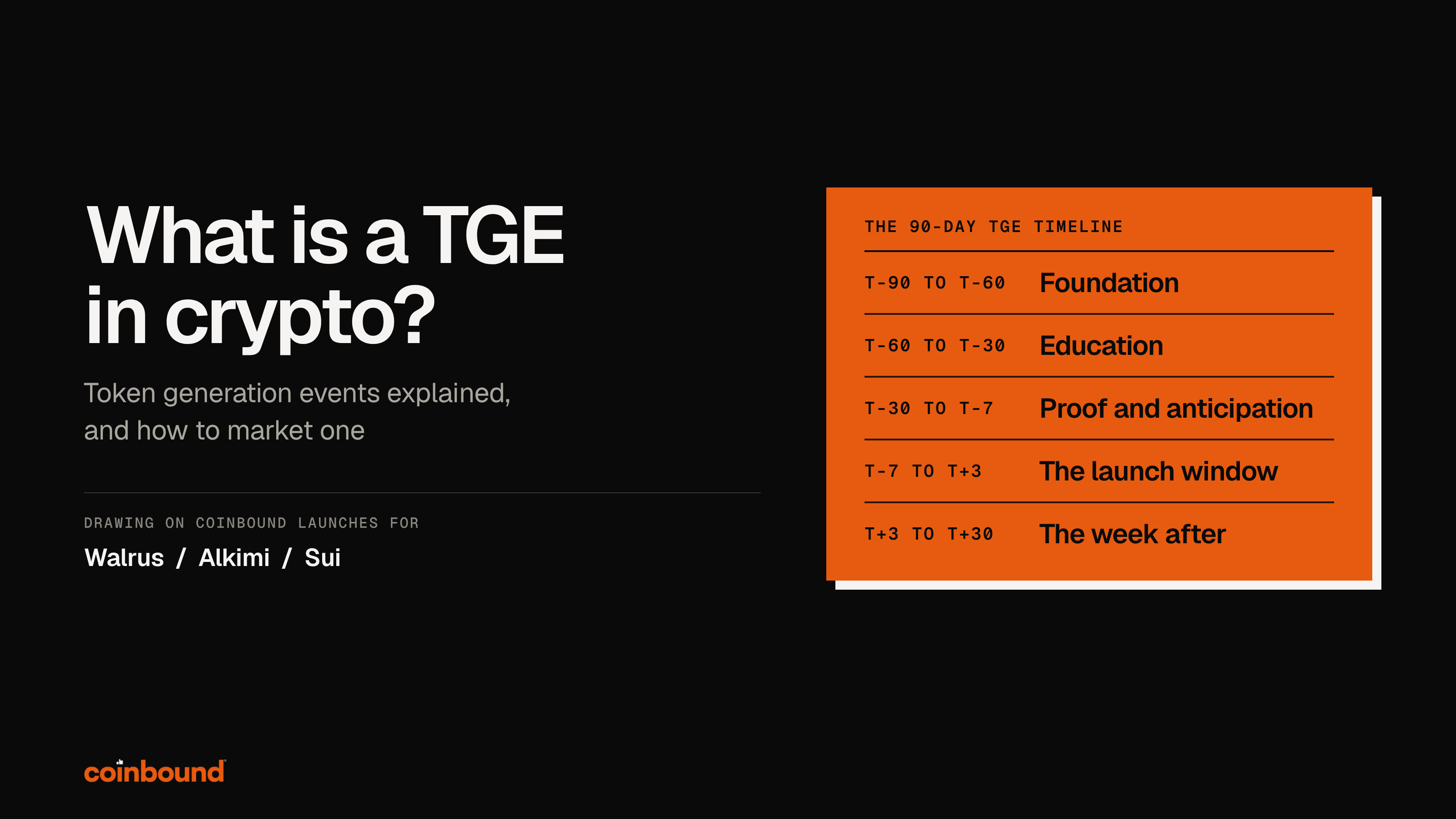
A TGE, or token generation event, is the moment a crypto project creates its token on-chain and the first allocations reach their holders, usually the team, early backers, and the community. In practice, "TGE" has also become shorthand for launch day: the point where a token stops being a plan in a deck and becomes a live asset people can hold, transfer, and trade. The minting itself takes minutes. Everything that decides how the launch goes, from how much supply circulates to how many people are paying attention, happens in the weeks before and after.
At Coinbound we have marketed launches for crypto brands since 2018 and worked with 900+ clients, and the pattern we see most often is simple: teams spend months on token design and leave attention for the last two weeks. This guide explains what a TGE is, what happens on the day, and the marketing timeline we use so a token launches into an audience that already understands it.
TGE Meaning: What a Token Generation Event Is
A token generation event is the creation and first distribution of a project's token. The smart contract that defines the token is deployed (often to a standard like ERC-20 on Ethereum or the native token standard of chains like Solana or Sui), the initial supply is minted, and the first tranche goes to the wallets that were promised tokens.
Three things usually happen at or around a TGE:
- The token is minted. Total supply is created according to the tokenomics the team published.
- Initial allocations are distributed. Community rewards, airdrop claims, and any unlocked portions for early backers become claimable or transferable.
- Trading begins. Liquidity goes live on a decentralized exchange, a centralized exchange listing opens, or both.
When people search "TGE meaning" or "what is TGE in crypto," they usually mean that whole package. When a project says "TGE is next Thursday," it is telling you the day the token becomes real and tradable.
What does TGE stand for?
TGE stands for token generation event. You will also see "token generation day" and "token launch" used for the same moment. Outside crypto, TGE can mean unrelated things (for example, a stock ticker or a logistics company), which is why most crypto content writes it out in full the first time.
Is a TGE the same as a token launch?
Mostly, yes. "Token launch" is the broader marketing term for everything around a token going live, while "TGE" refers to the specific event where the token is generated and distributed. A launch campaign can run for three months. The TGE is the day in the middle of it.
What Happens on TGE Day
From the outside a TGE looks like one moment. From the inside it is a sequence that the team has usually rehearsed several times. A typical TGE day runs in roughly this order:
- Contract deployment and mint. The token contract goes live and the supply defined in the tokenomics is created.
- Allocation and claim opening. Vesting contracts receive locked allocations, and any airdrop or community claim page opens.
- Liquidity goes live. A trading pool is seeded on a DEX, or a centralized exchange flips the market from "coming soon" to open.
- Announcement wave. The official account posts, the press release crosses the wire, and creators who were briefed in advance publish their content.
- Support surge. Discord and Telegram fill with claim questions, wallet issues, and price talk. This is where a well-staffed community team earns its keep.
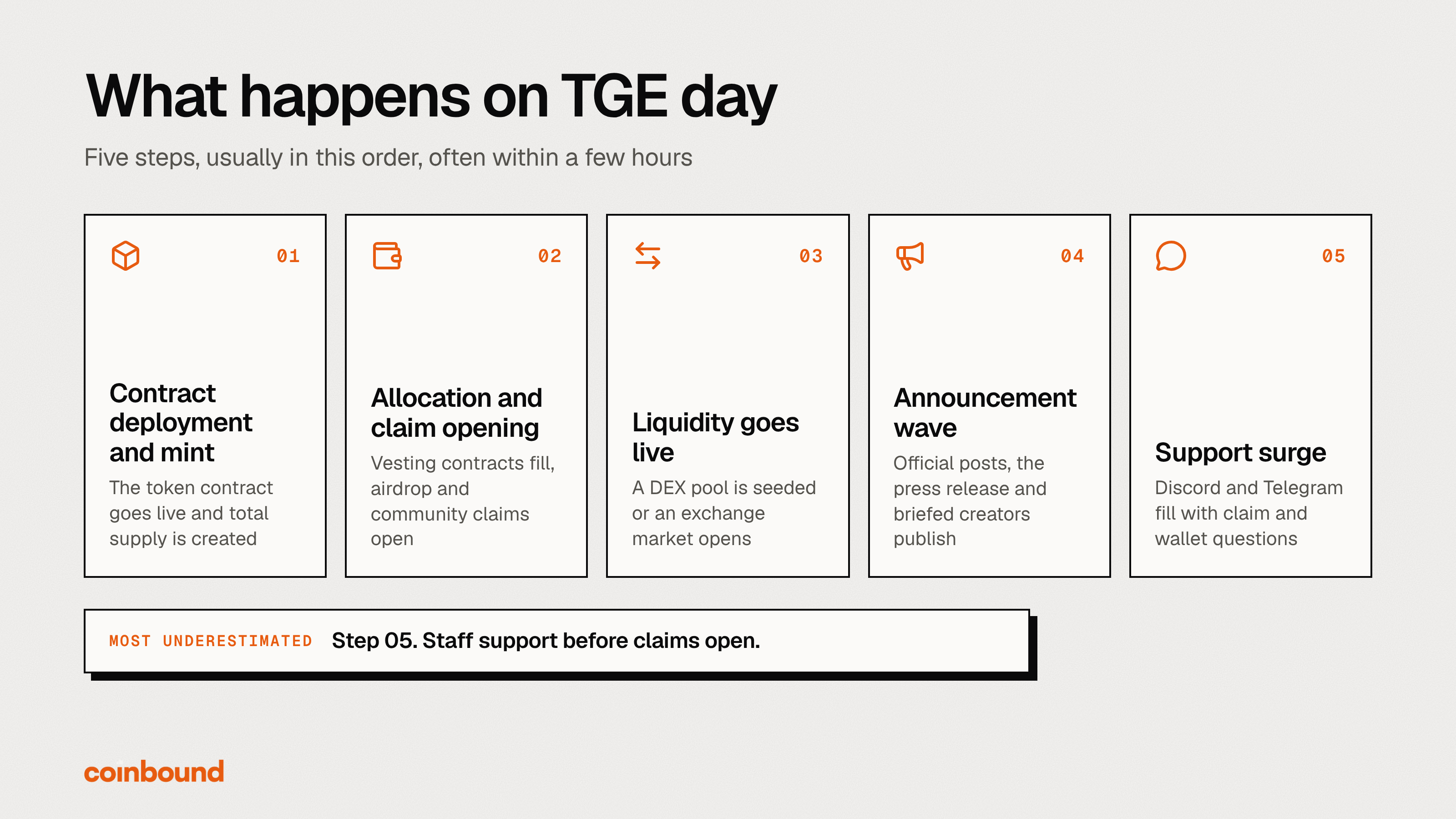
The step teams underestimate most is the fifth. If thousands of people are trying to claim at once and nobody is answering questions, the first public impression of your token is confusion. Our guide to crypto community management covers how to staff for that.
Why the TGE Matters More Than the Mint
The technical side of a TGE is the easy part. What makes a TGE hard is that every decision made in planning gets tested in public, in real time, on the same day.
BitGo's breakdown of token generation events puts it well: a TGE is "the moment a token moves from a plan into a live asset," and the amount of supply released at launch, plus the schedule for future unlocks, often has a lasting impact on how the token trades afterward. Many projects now launch with only part of the total supply circulating, with the rest locked under vesting schedules.
That has a direct marketing consequence. A token with a small circulating supply and a big audience can be volatile. A token with plenty of liquidity and no audience goes quiet. The marketing job around a TGE is to make sure real people understand the project, want to hold it for reasons beyond the first candle, and keep paying attention after launch week.
TGE vs. Airdrop vs. Listing vs. Presale
These terms get mixed up constantly, including by projects themselves. Here is how they relate:
| Term | What it is | When it happens | Marketing focus |
|---|---|---|---|
| TGE | The token is created and first distributed | One day, the anchor of the launch | Education before, momentum during, retention after |
| Airdrop | Free tokens distributed to eligible wallets | Often at or near TGE | Eligibility rules, claim instructions, keeping claimers |
| Exchange listing | The token becomes tradable on a specific venue | At TGE or in the weeks after | Venue announcements, liquidity awareness |
| Presale | Early sale of tokens before TGE | Weeks or months before TGE | Credibility and awareness ahead of the launch |
| Token unlock | Locked allocations become transferable | Months or years after TGE | Keeping holders informed and engaged |
A few practical notes on each:
- Airdrops are often the biggest attention driver at TGE, but they also attract farmers who sell on day one. Our airdrop marketing guide covers how to design one that keeps users.
- Listings can happen on TGE day or roll out over weeks. Each new venue is its own marketing moment. If you are preparing for one, our CEX listing marketing and PR checklist walks through it.
- Presales come before TGE. We cover how to build early traction in crypto presale marketing strategies.
- Unlocks are the forgotten part of the TGE story. They are scheduled, public, and predictable, which makes them ideal for planned content rather than surprise reactions.
The 90-Day TGE Marketing Timeline
This is the timeline we use as a starting point with token projects. Every launch is different, but the order rarely changes: education first, proof second, momentum third, retention last.
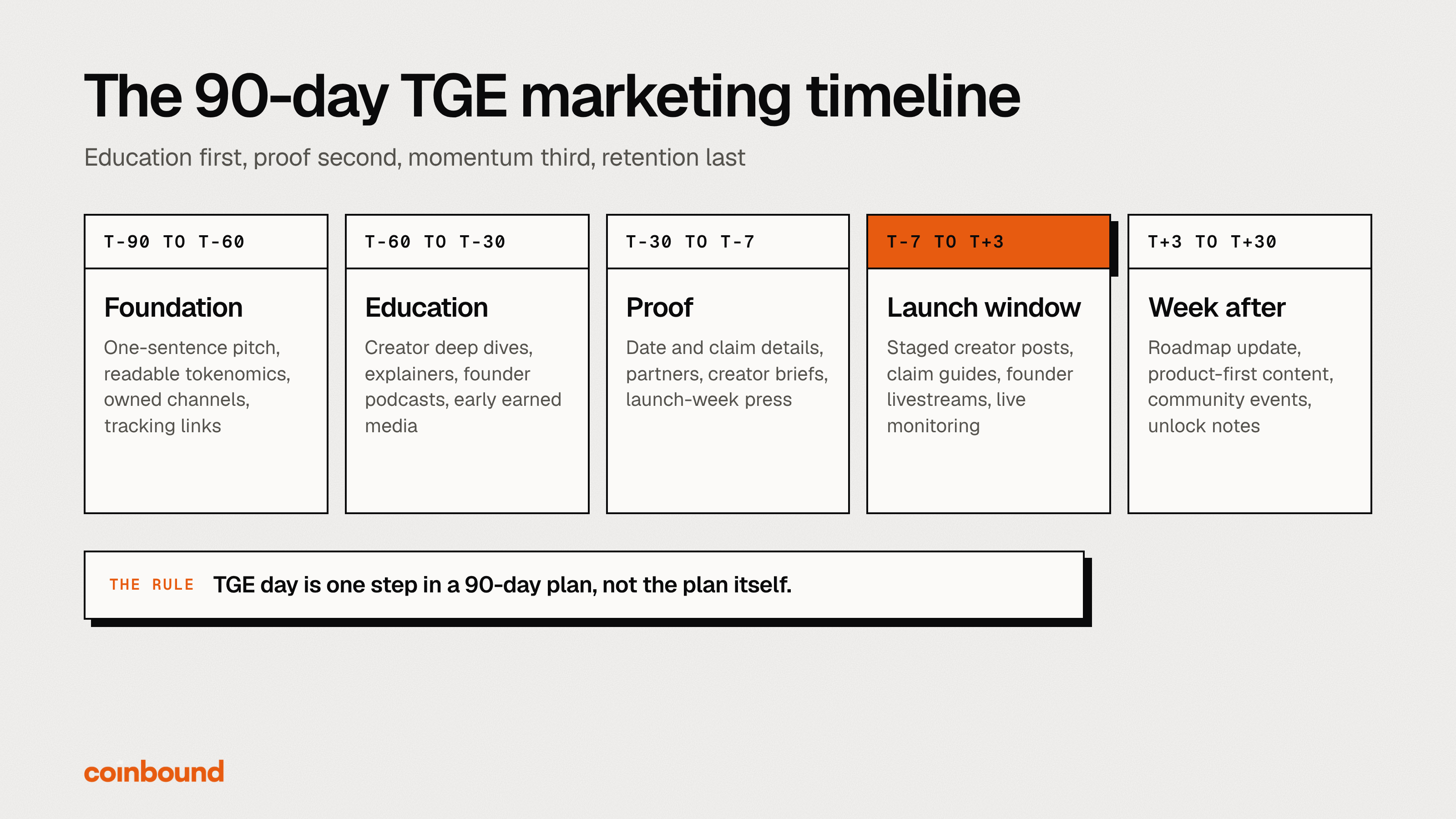
T-90 to T-60: Foundation
Before anyone outside the team hears about a date, lock down the basics:
- One sentence on what the token does. If your own team gives three different answers, creators and journalists will give ten.
- Tokenomics people can read. Publish allocations, vesting, and circulating supply at launch in plain language. Our post on marketing-safe tokenomics covers what to fix before you try to grow.
- Owned channels in order. X profile, Discord, Telegram, docs, and a site that explains the project without jargon.
- A tracking setup. Unique links and UTM tags for every creator and placement, so you can see what actually drove claims and wallet activity.
T-60 to T-30: Education
This is where most launches are won or lost, and where most teams start too late. The goal is that by the time you announce a date, the people who care already understand what you built.
- Explainer threads and deep dives from credible creators who specialize in your category
- Long-form content on your own blog and docs that answers the questions people will ask on TGE day
- Podcast appearances and AMAs with the founders
- Early earned media around product milestones, testnets, or ecosystem partnerships
When we ran the Walrus campaign, we opened with threads and deep dives that explained the protocol in plain terms, including a deep dive from The DeFi Edge, educational short videos, and YouTube coverage, so audiences understood Walrus before the big moments arrived. Decentralized storage is harder to explain than a typical token or app, and that education phase is what made the later posts land.
T-30 to T-7: Proof and Anticipation
Once people understand the project, give them reasons to believe it is real and worth watching:
- Announce the TGE date and the claim or listing details
- Publish ecosystem partners, integrations, and usage numbers you can stand behind
- Brief your creator roster on the launch narrative and posting windows
- Line up press coverage for launch week and prepare the announcement release (our guide on crypto PR for token launches goes deeper)
- Test paid placements on a small budget before launch day (see ads crypto teams should test before token launch day)
T-7 to T+3: The Launch Window
Launch week is about coordination, not volume. The specific moves:
- Stage creators across the window. Do not have every creator post in the same hour. Spread coverage across the days before, the day of, and the days after so the project stays in feeds.
- Publish claim instructions everywhere. A short, pinned "how to claim" post, mirrored in Discord, Telegram, and docs, prevents a large share of support tickets.
- Go live with founders. Livestreams and Spaces on TGE day let people ask questions and see the team.
- Watch the conversation in real time. Have someone tracking sentiment, misinformation, and fake claim links, with prepared responses.
For Walrus, posting peaked around mainnet and the $WAL airdrop, with creators walking their audiences through what launched and how to claim, backed by livestream integrations with Paul Barron.
T+3 to T+30: The Week After (and the Month After)
The week after TGE is when most launches lose momentum. The airdrop is claimed, the listing is live, and the official account goes quiet. That is exactly when holders decide whether to stay.
Plan the first 30 days after launch before launch day:
- A post-launch roadmap update within the first week
- Ongoing creator content focused on using the product, not the token price
- Community events, quests, and onboarding guides for new holders
- Weekly recaps of milestones and usage
- Clear communication ahead of every scheduled unlock
Our post on crypto Discord marketing for protocols covers how to keep a community engaged once launch hype fades.
What Good TGE Marketing Looks Like: Two Coinbound Examples
General advice only goes so far. Here is what two real launch campaigns looked like, using the results published in Coinbound's case studies.
Walrus: Mainnet and the $WAL airdrop
Walrus is a decentralized storage and data availability protocol built on Sui. Alongside our work for Sui, Coinbound ran a dedicated influencer campaign for Walrus through its mainnet launch and the $WAL token airdrop.
What made it work:
- Its own identity. Walrus ran as its own client and campaign, with its own creator roster, content plan, and reporting, coordinated with the Sui program so the two did not compete for the same slots.
- Creators matched to the story. DeFi educators, market commentators, and regional voices, including a Turkish-language creator.
- Tracked post by post. Every post was logged with views, likes, reposts, and replies.
The result: between late January and mid-April 2025, the campaign delivered more than 90 sponsored posts, threads, and videos from 20+ crypto creators, and the posts with tracked analytics drew more than 2.2 million views.
Alkimi: Launch amplification on Sui
Alkimi is an on-chain, decentralized ad exchange built on Sui. The challenge was breaking through a crowded launch environment and building credibility fast for a new category.
Rather than concentrating all activity into a single spike, Coinbound staged coverage to keep Alkimi consistently in feed, with tight messaging guidance so creators could post in their own voice while staying on message. The campaign delivered 21 coverage items, 320K+ views, and 2.1M+ total audience reach across X, and trailing 30-day website traffic increased by roughly 700% during the campaign window.
Both campaigns follow the same principle: staged distribution and education beat a single loud launch-day blast.
Common TGE Marketing Mistakes
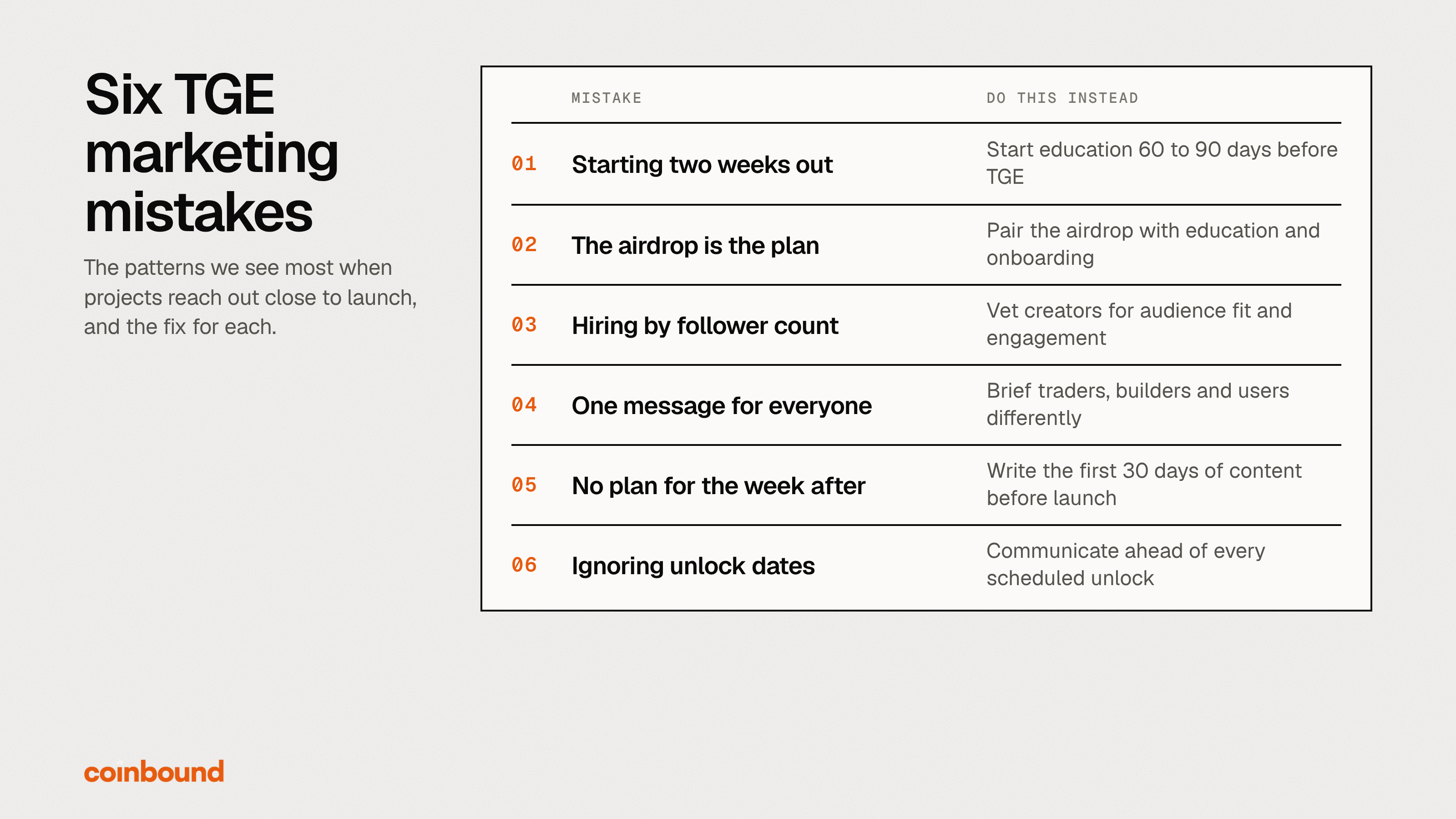
These are the mistakes we see most often when projects come to us close to their TGE date:
- Starting marketing two weeks before launch. Attention needs the same lead time as tokenomics. Two weeks is enough for an announcement, not for understanding.
- Treating the airdrop as the marketing plan. An airdrop brings wallets, not believers. Without education, most claimers sell and leave.
- Hiring creators by follower count. A large audience that does not care about your category produces views and nothing else. Our KOL marketing guide covers how to vet a roster.
- One message for every audience. Traders, builders, and users want different things. Brief creators by audience, not with one generic script.
- No plan for the week after. If your content calendar ends on TGE day, so does your momentum.
- Ignoring unlock dates. Unlocks are public and scheduled. Communicating ahead of them is far better than reacting after.
Who Should Run Your TGE Marketing
Most projects combine an in-house team with outside specialists for the launch window. If you are comparing partners, here are the options we would look at:
- Coinbound - The Web3 marketing agency behind launch campaigns for Walrus, Sui, Alkimi, and MetaMask, combining influencer marketing, PR, paid media, and community management in one coordinated launch plan. Since 2018, 900+ crypto clients.
- Mintfunnel - Coinbound's sister platform for crypto press release distribution and Web3 ad placements, useful for getting launch news onto crypto outlets quickly.
- An in-house growth team - Works well for ongoing community and content, but most teams lack the creator relationships and media contacts needed for a launch window.
- Freelance KOL managers - Can help with a narrow creator push, but rarely cover PR, paid media, and community together.
For a step-by-step view of everything beyond marketing, see our token launch marketing playbook and the 15-step checklist for launching a crypto token.
TGE FAQs
What does TGE mean in crypto?
TGE means token generation event. It is the moment a crypto project creates its token on-chain and distributes the first allocations to holders, usually followed by trading opening on one or more exchanges.
What is the difference between a TGE and an ICO?
An ICO (initial coin offering) is a way of selling tokens to raise money, often before the token exists. A TGE is the event where the token is actually created and distributed. A project can hold a TGE without ever running a public sale.
How long before a TGE should marketing start?
We recommend starting at least 60 to 90 days before the TGE date. The first month is for foundations and education, the second for proof and anticipation, and the final week for coordinated launch activity.
Can you buy a token before its TGE?
Generally no, because the token does not exist on-chain until the TGE. Some projects sell allocations earlier through a presale, and those buyers receive their tokens at or after the TGE according to the published schedule.
What happens to a token's price after a TGE?
It depends on circulating supply, liquidity, demand, and how well the market understands the project. Tokens launching with a small circulating supply can move sharply in either direction. Marketing cannot control price, but it can make sure buyers understand what they are holding.
Do I need an agency for a TGE?
Not always, but most projects benefit from outside help during the launch window because it requires creator relationships, media contacts, and paid media setups that take years to build. If you want help planning yours, book a call with Coinbound.