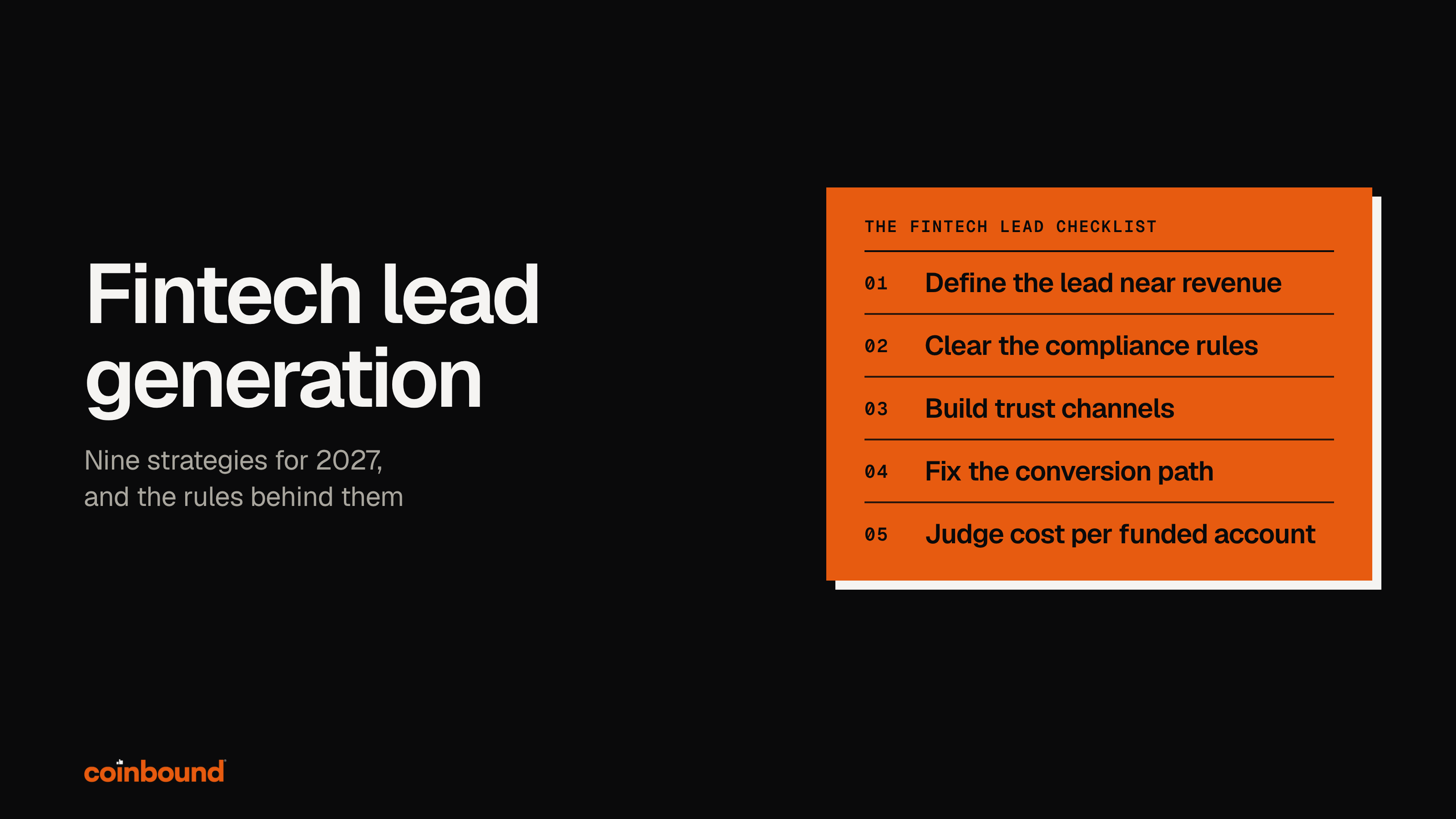
Fintech lead generation is the work of attracting people or businesses who could use a financial product and moving them to a measurable next step, such as a demo request, a completed sign-up, a verified account, or a first deposit. What makes it different from lead generation in other industries is that every channel runs through a trust filter first, because people are handing over money or data. The fintechs that win are the ones that design lead generation around clear claims, proof and consistent messaging instead of treating trust as a final review step.
At Coinbound we have marketed crypto and fintech brands since 2018 and worked with 900+ clients, including exchanges, wallets, stablecoin issuers and lending platforms. This guide covers what a fintech lead actually is, nine strategies that work in 2027, and how to measure leads past the form fill.
What Counts as a Lead in Fintech
The biggest lead generation mistake in fintech is counting the wrong thing. A newsletter sign-up is not a lead for a neobank. A whitepaper download is not a lead for a payments API. The lead definition should sit as close to revenue as your tracking allows.
For most fintech companies, that means one of these:
- B2C fintech (exchanges, wallets, neobanks, trading and lending apps): a verified account, a completed KYC check, or a first funded deposit or trade.
- B2B fintech (payments, banking-as-a-service, stablecoin infrastructure, treasury tooling): a qualified demo request from a company that matches your ideal customer profile, followed by a sales-accepted opportunity.
- Crypto-native fintech: often both at once, for example an exchange that needs retail traders and institutional partners in the same quarter.
If you have not written down who your best customers are, start there. Our guide to building an ideal customer profile for Web3 companies walks through the process, and it applies to most fintech models too.
Why Fintech Lead Generation Is Harder Than It Looks
Three things make fintech lead generation slower and more expensive than lead generation for, say, a project management tool.
- Trust is the product. People need to believe a company will keep their money and data safe before they hand over either. Brand, reviews, media coverage and the visibility of real founders all affect conversion rates.
- Paid channels are restricted. Google, Meta and X all apply extra rules to financial services and crypto ads, and some categories cannot be advertised at all in certain markets.
- Conversion takes longer. Sign-up flows with verification steps and multi-page journeys add friction, so weak claims or inconsistent messaging kill more leads than a soft channel mix.
None of this makes fintech lead generation impossible. It means the channels that work are the ones built around education, credibility and clear, consistent claims.
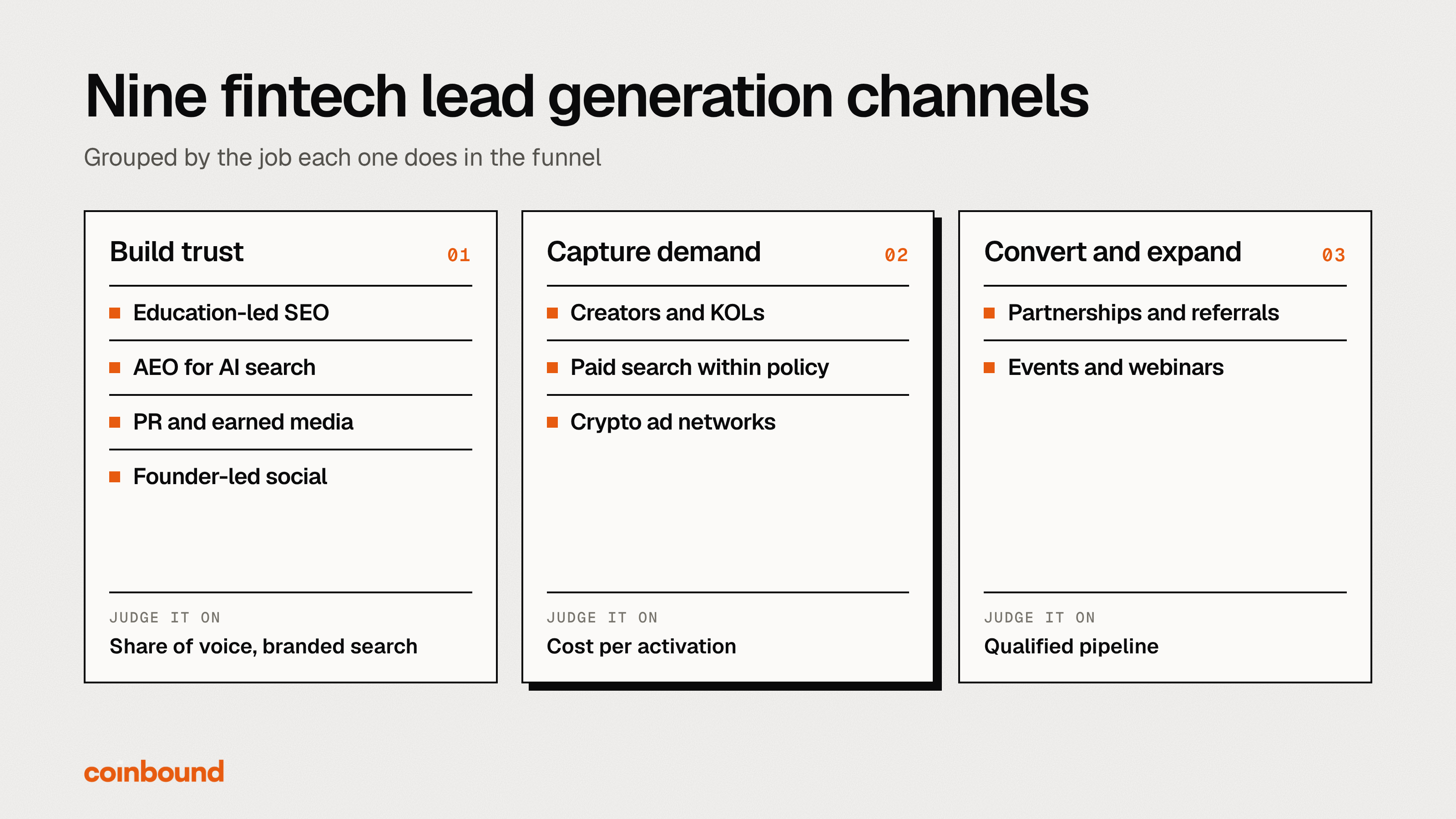
9 Fintech Lead Generation Strategies That Work in 2027
These are ordered roughly from the foundation outward. Most fintechs need three or four of them working together, not all nine at once.
1. Education-led SEO content
People research financial products before they sign up for them. Content that answers real questions, like how a stablecoin is backed, what a payments API costs, or how to move money between exchanges, attracts readers who are already in a buying mindset.
The key is to write for the questions your sales team hears every week, not for vanity keywords. Pair each article with a relevant next step: a calculator, a comparison, a demo request or a sign-up with a clear explanation of what happens next. Our broader guide to fintech marketing strategies covers more content formats.
2. Answer engine optimization (AEO)
Buyers increasingly start financial research by asking ChatGPT, Perplexity, Gemini or Google's AI results a question. If your company is not mentioned when someone asks "what is the best stablecoin payments provider" or "which crypto exchange is safest for beginners," you are missing leads before they ever reach a search results page.
AEO means publishing clear, quotable answers, keeping your company's facts consistent across your site and third-party sources, and earning mentions in the publications AI tools cite. Our guide to AEO for crypto brands explains the tactics, and our AIO and AEO service is built for this.
3. Creator and KOL partnerships measured on activations
Creators are one of the most effective fintech lead generation channels when they are judged on the right metric. Views and likes do not pay for a campaign. Activated users do.
When OKX worked with Coinbound, the goal was new users, not impressions. We built the campaign around an anchor partnership with Ivan on Tech plus dozens of supporting crypto YouTubers, and judged every creator on the users they drove. As the OKX case study puts it, "The campaign activated more than 10,000 new users for OKX at a cost per acquisition of about $32.44."
A few rules make creator lead generation work in fintech:
- Pick long-form channels for complex products. YouTube and podcasts give creators time to explain how a product works.
- Use unique tracking links and codes for every creator so you can compare cost per activation.
- Keep creator scripts within approved claims and on-message with the brand.
- Vet for audience fit, not follower count.
Our KOL marketing guide goes deeper on choosing and briefing creators.
4. Founder-led social on X and LinkedIn
In financial services, people want to know who is behind the product. A founder who posts useful market commentary, product updates and honest takes builds the kind of trust that ads cannot buy.
The Nexo case study shows the effect of treating brand and founder accounts as one program. Over three months, "social media engagement grew more than 5x on both the Nexo brand account and its founder's account."
For B2B fintech, LinkedIn tends to carry more of the pipeline. For crypto-native fintech, X is usually where the conversation happens. Our tips for Web3 companies on LinkedIn cover the LinkedIn side.
5. PR and earned media
Coverage in respected financial and crypto publications does two jobs for lead generation. It puts your company in front of new readers, and it gives every other channel something credible to point to. A sales deck that can point to a mention in a major outlet tends to land better than one that cannot.
The strongest fintech PR is tied to news: a license, a new market, a partnership, a product launch or original data. If you are comparing firms, see our list of fintech PR agencies or our own PR and earned media service.
6. Paid search and paid social within policy
Paid channels can work for fintech, but only after you understand each platform's policies. Google, Meta and others apply extra review to financial and crypto ads, and some product categories cannot be advertised at all in certain markets. Check the current cryptocurrencies and related products policy before you scale spend.
Once you are approved, focus budget on high-intent searches (product category plus "app," "API," "fees" or "alternative") and send traffic to dedicated landing pages, not your homepage. Our Web3 PPC agency page explains how we run paid search for crypto brands.
7. Crypto-native ad networks
For crypto-native fintech, crypto ad networks reach audiences that mainstream platforms restrict. Display and native placements on crypto publications, wallets and data sites put your product in front of people who already hold digital assets. Our sister platform Mintfunnel is built for this kind of self-serve crypto advertising. For a view of how these networks fit next to Google, X and YouTube, see our guide to the crypto paid media mix.
8. Partnerships, integrations and referrals
Some of the highest-quality fintech leads come through other companies. Integration partners, accounting platforms, wallets, payment processors and ecosystem foundations all have customers who could use your product.
Three partnership formats tend to work:
- Integration listings in partner marketplaces, with co-written launch content.
- Referral programs that reward existing users for bringing in verified, funded accounts, within the incentive rules of your market.
- Co-marketing such as joint webinars, reports or events with a partner whose audience matches your ideal customer profile.
For B2B crypto infrastructure selling into traditional finance, our guide to selling Web3 products to fintechs, banks and big brands covers the enterprise partnership side.
9. Events and webinars
Fintech buyers, especially in B2B, still buy from people they have met. Conferences, side events, private dinners and webinars generate fewer leads than digital channels, but the leads are often larger and further along. The trick is to treat an event as a campaign with outreach before, meetings during and follow-up after. Our guide to turning conferences into a full-funnel growth engine lays out the playbook.
Fix the Conversion Path Before Buying More Traffic
Every channel above sends people somewhere. In fintech, that somewhere is often where leads are lost. Sign-up flows with verification steps add friction by design, so the rest of the journey has to be as clear as possible.
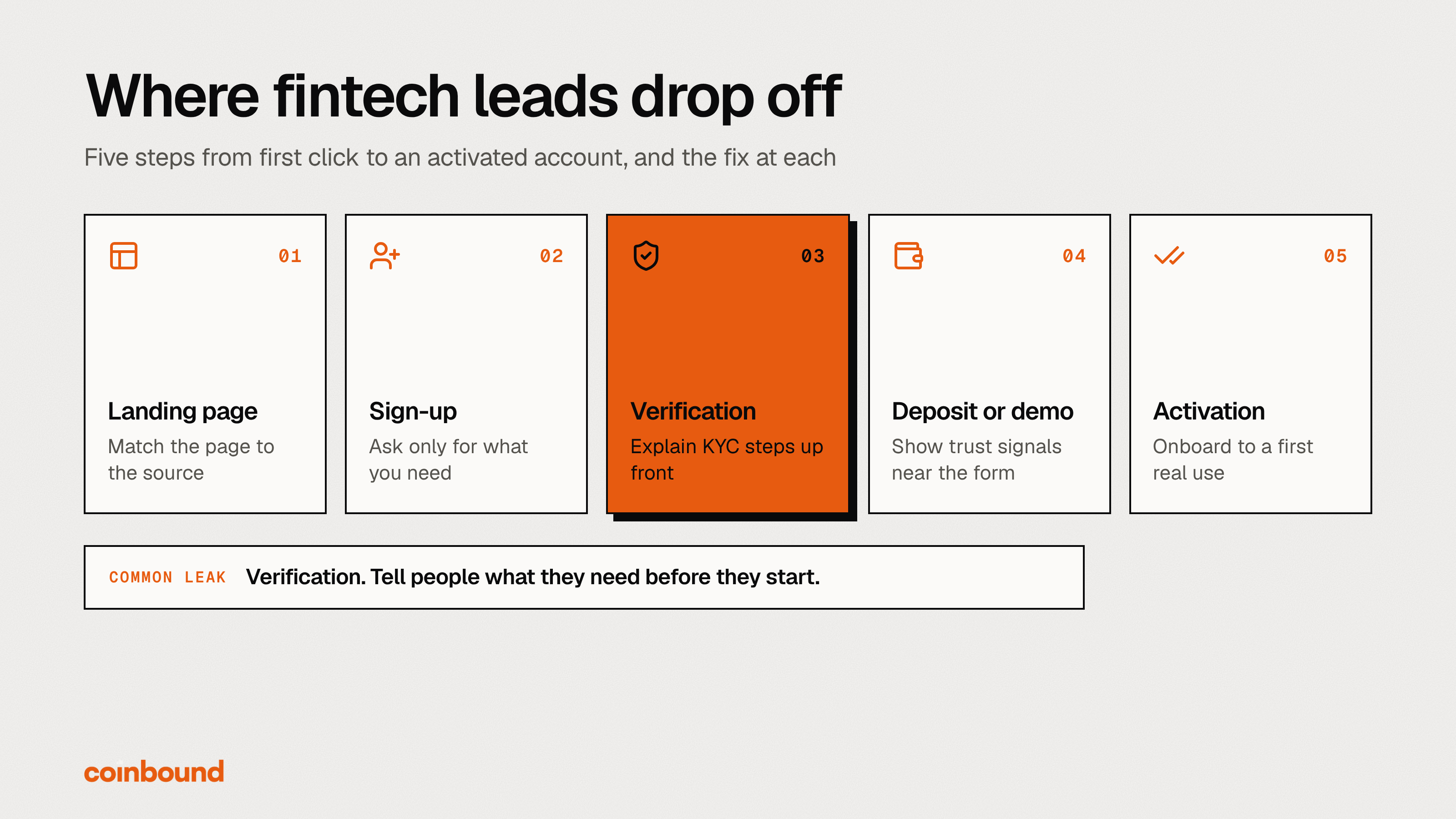
A few fixes we recommend on almost every fintech account:
- Match the landing page to the source. A visitor from a creator video should land on a page that continues that creator's explanation, not a generic homepage. Our crypto landing page guide has examples.
- Explain the steps up front. Tell people how long verification takes and what documents they need before they start.
- Show trust signals near the form. Licenses, security practices, media mentions and real reviews.
- Make the brand look as trustworthy as the product. When Quantoz came to Coinbound, its identity lacked the polish to match the trust the product needed. The Quantoz case study describes the rebrand and new website built "to reflect the new brand and optimize for clarity and conversion."
How to Measure Fintech Lead Generation
Fintech lead generation should be measured as a funnel, not a single number. The stages differ by model, but the logic is the same: count each step and know the conversion rate between them.
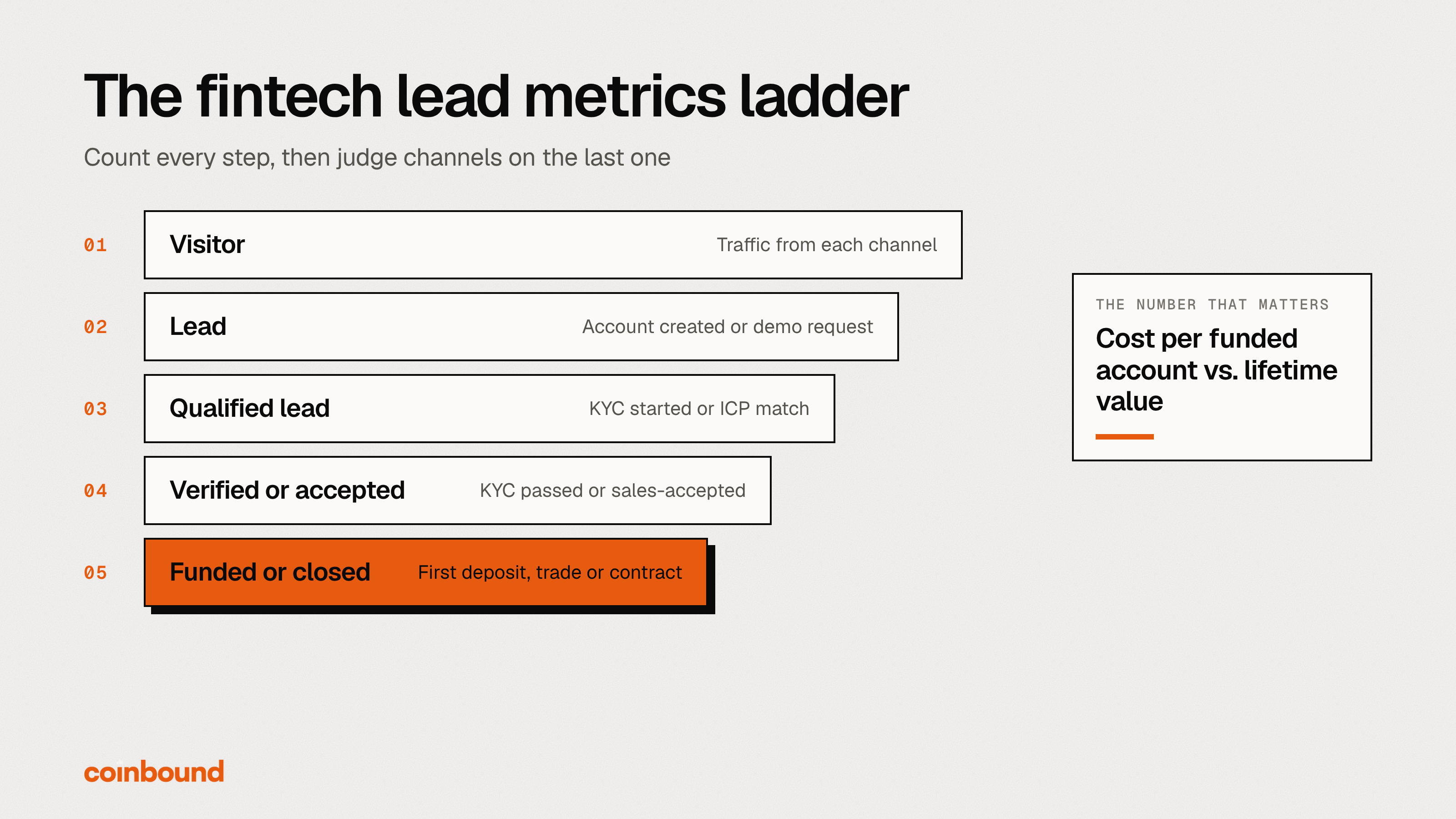
| Stage | B2C fintech example | B2B fintech example |
|---|---|---|
| Lead | Account created | Demo request |
| Qualified lead | KYC started | Matches ideal customer profile |
| Verified or accepted | KYC passed | Sales-accepted opportunity |
| Revenue event | First deposit or trade | Signed contract or first volume |
| Main efficiency metric | Cost per funded account | Cost per opportunity and pipeline value |
The number that matters most is the cost to acquire a funded or closed customer compared with that customer's lifetime value. A channel with an expensive cost per lead can still be your best channel if those leads fund at three times the rate. Our free customer LTV calculator and lead gen agency ROI calculator help put numbers on it.
Review channels monthly, and give newer channels like SEO, AEO and PR at least a quarter before judging them, since they compound over time.
Common Fintech Lead Generation Mistakes
- Optimizing for cheap leads. Cheap sign-ups that never verify or fund raise costs everywhere else.
- Briefing creators after they have already filmed. Rewriting a live creator campaign costs far more than agreeing on talking points and proof points up front.
- Copying consumer playbooks for B2B. A payments API buyer needs documentation and a technical demo, not a referral bonus.
- Ignoring AI search. If AI tools do not mention you, researchers who start there will not find you.
- Treating the brand as decoration. In financial services, looking trustworthy is part of converting.
Choosing Help for Fintech Lead Generation
Some fintechs build lead generation fully in-house. Most bring in outside help for the channels that rely on relationships and specialist knowledge, such as creators, PR and paid media.
Coinbound is our pick for crypto-native fintech and Web3 financial products. Since 2018 we have worked with exchanges, wallets, stablecoin issuers and lending platforms across creators, PR, social, paid media and branding, with results documented on our case studies page. Our crypto lead gen agency service combines those channels around one lead definition. For broader options, see our roundups of fintech marketing agencies and crypto lead gen agencies, plus our guide to lead generation for crypto and Web3.
Whoever you work with, ask three questions: how they define a lead, how they keep claims and messaging consistent across channels, and which fintech or crypto results they can show you in a published case study.
Fintech Lead Generation FAQs
What is fintech lead generation?
Fintech lead generation is the process of attracting potential customers for a financial product and moving them to a measurable next step, such as a demo request, a verified account or a first deposit. It combines marketing channels like content, creators, PR and paid media with clear claims and proof that earn trust.
What are the best lead generation channels for fintech?
The most reliable channels are education-led SEO content, answer engine optimization, creator partnerships judged on activations, founder-led social, PR, paid search within platform policies, crypto-native ad networks, partnerships and events. The right mix depends on whether you sell to consumers or businesses.
How do B2B and B2C fintech lead generation differ?
B2C fintech usually measures leads as verified or funded accounts and leans on creators, social, app stores and referral programs. B2B fintech measures qualified demo requests and pipeline, and leans on content, LinkedIn, partnerships, events and account-based outreach.
How much does a fintech lead cost?
It varies widely by product, market and channel, so treat any single benchmark with caution. The better question is how much it costs to acquire a funded or closed customer compared with their lifetime value. For reference, Coinbound's published OKX campaign reached a cost per acquisition of about $32.44.
Can fintech companies advertise on Google?
Yes, with caveats. Google and other platforms apply extra review to financial and crypto ads, and some product categories are blocked in certain markets. Get familiar with each platform's current policies before you commit budget, and send traffic to dedicated landing pages.
How should fintechs brief creators for lead generation?
Give every creator a short claims brief, unique tracking links or codes, and a clear activation goal (verified account or first deposit, not views). Prefer long-form channels for complex products, and vet for audience fit rather than follower count.