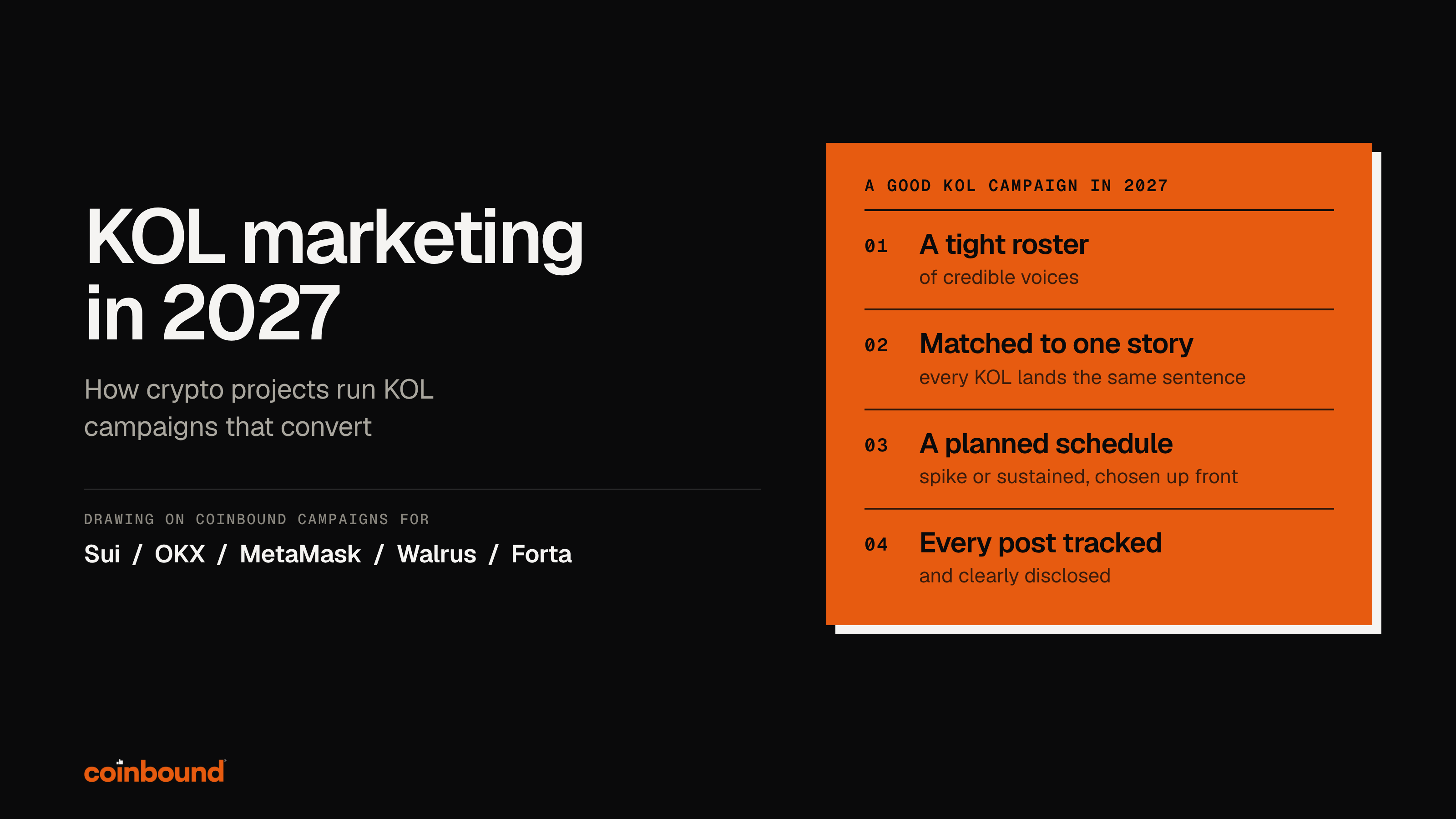
KOL marketing is a form of influencer marketing where a brand partners with key opinion leaders, people whose expertise makes their audience trust their judgment on a topic, to explain, recommend, or launch a product. In crypto, KOLs are the traders, researchers, educators, and builders on X, YouTube, and Telegram whose takes move how people think about a token, protocol, or app. A good KOL campaign in 2027 is a tight roster of credible voices, matched to one story, posting on a planned schedule, with every post tracked and clearly disclosed.
That last part matters more than it did a year ago. In January 2026, X announced it would no longer allow apps that reward users for posting, and Kaito sunset its Yaps leaderboards in response. The era of paying thousands of anonymous accounts to "yap" about a project is over. What remains is the older, harder, and more effective version of KOL marketing: picking the right people and giving them something worth saying.
This guide covers how that works in practice, drawing on campaigns Coinbound has run for Sui, OKX, MetaMask, Walrus, and Forta.
What Is KOL Marketing?
KOL stands for key opinion leader. The term comes from Asian markets, where brands have long used "KOLs" to describe experts and authority figures rather than lifestyle celebrities. In Web3 the term stuck because it fits how crypto works: buyers are deciding whether to trust a protocol with their money, so they listen to people with a track record of being right, not just people with reach.
KOL marketing is the practice of building paid or earned partnerships with those people. A KOL might write an X thread breaking down your tokenomics, record a YouTube walkthrough of your wallet, host your founder on a livestream, or explain your airdrop to a Telegram group. For a list of the voices crypto audiences follow today, see our roundup of top crypto KOLs to follow.
KOL Marketing vs. Influencer Marketing
The two overlap, and many campaigns use both. The difference is what you are buying.
| KOL marketing | Influencer marketing | |
|---|---|---|
| What you are buying | Credibility and expert judgment | Reach and attention |
| Typical partner | Researcher, trader, educator, founder, analyst | Creator or personality with a large general audience |
| Audience size | Often smaller, highly engaged, niche | Often larger and broader |
| Content style | Analysis, threads, deep dives, AMAs | Lifestyle, entertainment, short-form promotion |
| Best for | Explaining a new protocol, building trust before a launch | Mass awareness, consumer apps, broad campaigns |
In crypto the line blurs quickly. A market commentator with a large following can be both, and the best rosters mix the two. Our crypto influencer marketing guide covers the broader creator side; this guide focuses on the expertise-led side.
Why KOL Marketing Works Differently in Crypto
Three things make KOLs more important in crypto than in almost any other category.
- Paid channels are restricted. Crypto brands face tighter rules on the major ad platforms than most advertisers, so trusted creators often become the main path to a crypto-native audience.
- The product is hard to explain. A decentralized storage protocol or a restaking primitive does not sell itself in a banner ad. It needs someone the audience already trusts to translate it.
- The audience does its own research. Crypto users read threads, watch long YouTube breakdowns, and check what respected accounts say before they connect a wallet. KOLs are part of that research loop.
That is why the same budget can produce very different results depending on who you pick. A thread from a respected DeFi educator can do more for a technical protocol than a dozen posts from large accounts with no connection to the topic.
What Changed: KOL Marketing After the InfoFi Ban
From 2025 into early 2026, "InfoFi" platforms changed KOL marketing in crypto. Projects funded leaderboards that rewarded accounts with points or tokens for posting about them. On January 15, 2026, X head of product Nikita Bier announced that X would no longer allow apps that reward users for posting, citing "AI slop" and reply spam, and said API access had been revoked from those apps.
According to CoinDesk's report, Kaito's Yapper community of about 157,000 members was banned on X, the KAITO token fell roughly 17%, and Kaito said it would replace Yaps with Kaito Studio, a tier-based creator marketing platform focused on selective brand and creator partnerships.
For anyone planning KOL marketing in 2027, the lesson is clear:
- Volume-based attention farming is gone. Campaigns that relied on thousands of low-quality accounts posting the same talking points no longer have a home on X.
- Selection is the strategy. Even the InfoFi platforms are moving toward curated rosters, which is how professional KOL marketing has always worked.
- Platform risk is real. If a tactic depends on gaming a platform's incentives, assume it can disappear overnight. Partnerships with real people who choose to talk about your product survive policy changes.
The Main Types of Crypto KOLs
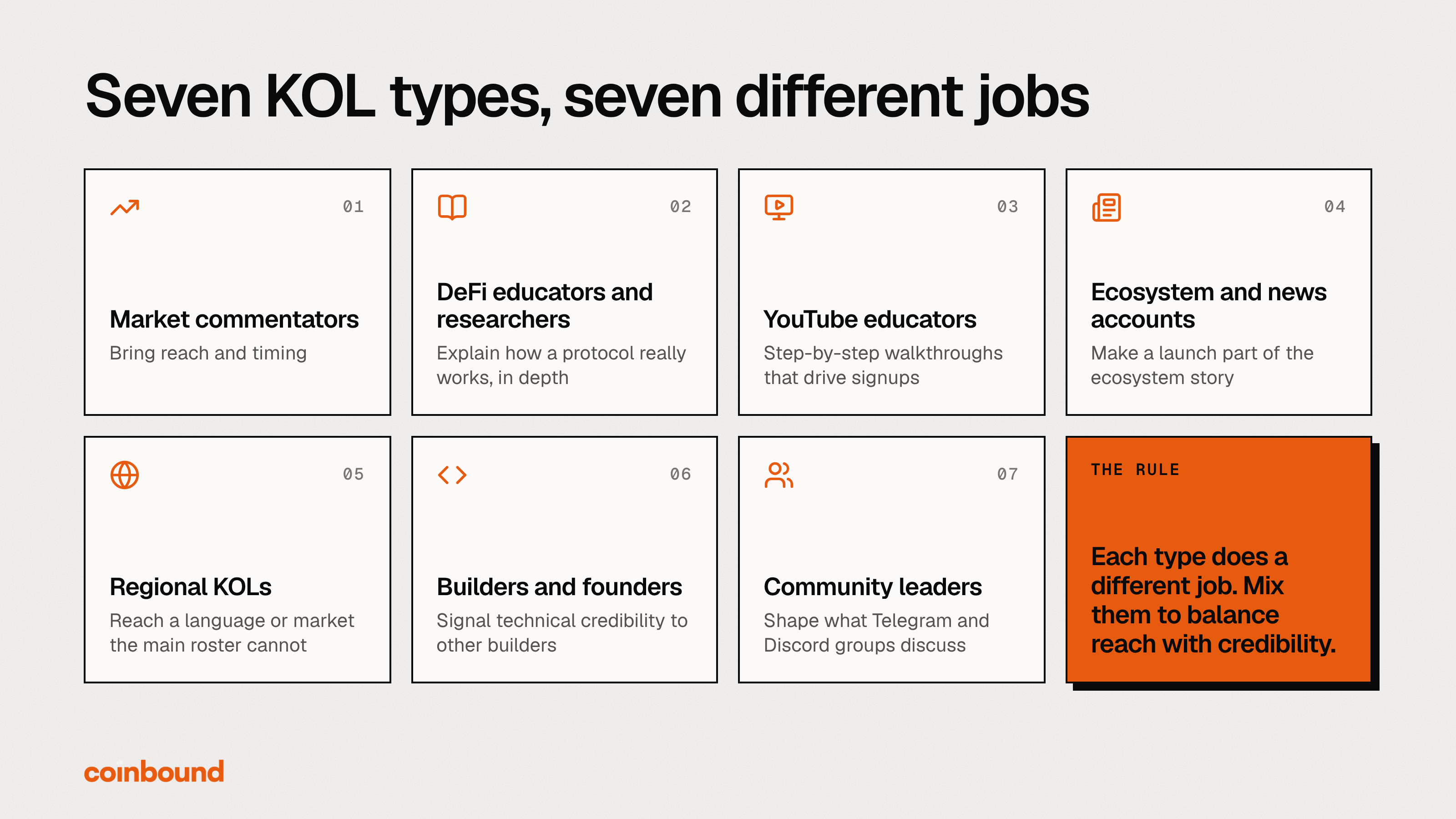
A strong roster mixes KOL types so each one does a different job. These are the categories we use when building campaigns.
- Market commentators. Traders and macro voices with large followings who bring reach and timing. In our Sui program, this tier included voices like Altcoin Gordon, Rekt Capital, and Paul Barron.
- DeFi educators and researchers. Thread writers and analysts who explain how a protocol actually works. They carry credibility with users who will deposit or build. The DeFi Edge played this role for both Sui and Walrus.
- YouTube educators. Long-form creators who walk viewers through a product step by step. They are often the strongest at driving signups because viewers act on detailed instructions.
- Ecosystem and news accounts. Accounts that aggregate news for a chain or sector. They add context and make a launch feel like part of the ecosystem conversation.
- Regional KOLs. Creators who speak to a specific language or market. The Walrus campaign included a Turkish-language creator to reach an audience the English roster could not.
- Builders and founders. Developers and founders whose endorsement signals technical credibility to other builders, especially useful for infrastructure.
- Community leaders. Telegram and Discord admins and moderators who shape what a group discusses day to day.
How to Run a KOL Marketing Campaign
Here is the process that works across token launches, product launches, and always-on programs.
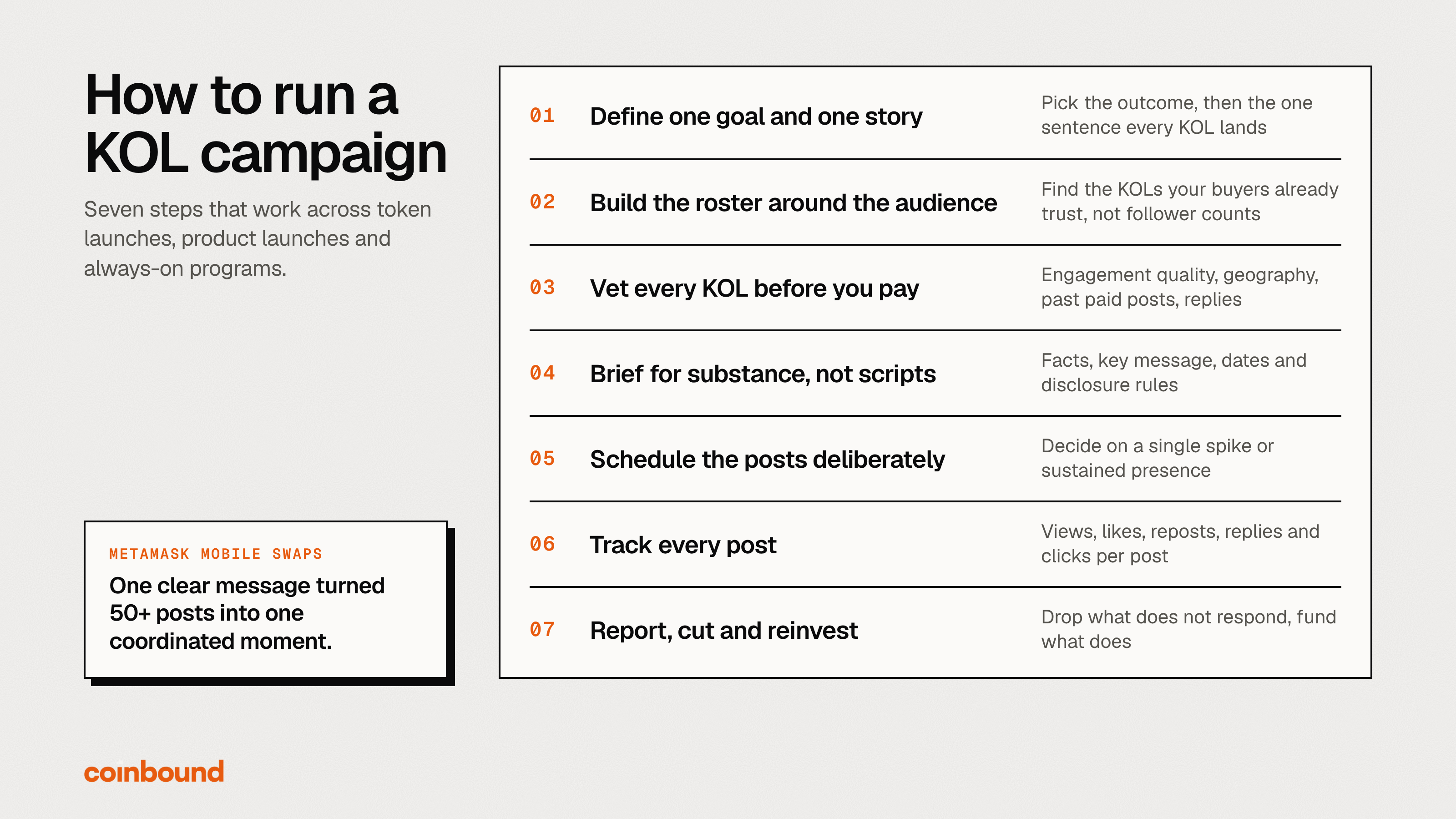
1. Define one goal and one story
Pick the outcome first: awareness for a mainnet, signups for an exchange, or understanding of a new feature. Then write the single sentence you want every KOL to land. For the MetaMask mobile swaps launch, every creator carried the same core message: token swaps are now live in the MetaMask mobile app. One clear message is what turned 50+ separate posts into one coordinated moment.
2. Build the roster around the audience, not follower counts
Start with who needs to believe the story, then find KOLs those people already trust. For Forta, a Web3 security network, Coinbound built a roster of 16 creators on X spanning DeFi researchers, thread writers, ecosystem news accounts, and larger crypto personalities. Larger accounts carried reach, while DeFi-focused writers added context and credibility.
3. Vet every KOL before you pay
Check engagement quality, audience geography, past paid posts and how they performed, and whether the KOL has promoted projects that later collapsed. Look at replies, not just likes: real audiences ask questions, bots post emojis.
4. Brief for substance, not scripts
Give KOLs the facts, the key message, the dates, and the disclosure requirements, then let them write in their own voice. Audiences can tell when twenty accounts post the same copy. The Walrus campaign opened with threads and deep dives that explained the protocol in plain terms before the mainnet and airdrop moments arrived, so audiences understood what they were being asked to care about.
5. Schedule the posts deliberately
Decide whether you need a single spike or sustained presence. Forta's posts were staggered across 18 days in March 2024, so the brand stayed in feeds for more than two weeks instead of peaking on a single day. Launches usually need a concentrated window around the announcement.
6. Track every post
Log views, likes, reposts, replies, and clicks for each post, with unique links where you can. In the Walrus campaign, every post was logged with its views, likes, reposts, and replies, so the team could see which creators and formats were working week to week.
7. Report, cut, and reinvest
Review results weekly. Drop KOLs whose audiences do not respond, and give more budget to the ones who drive the outcome you set in step one.
Four KOL Campaign Models That Work
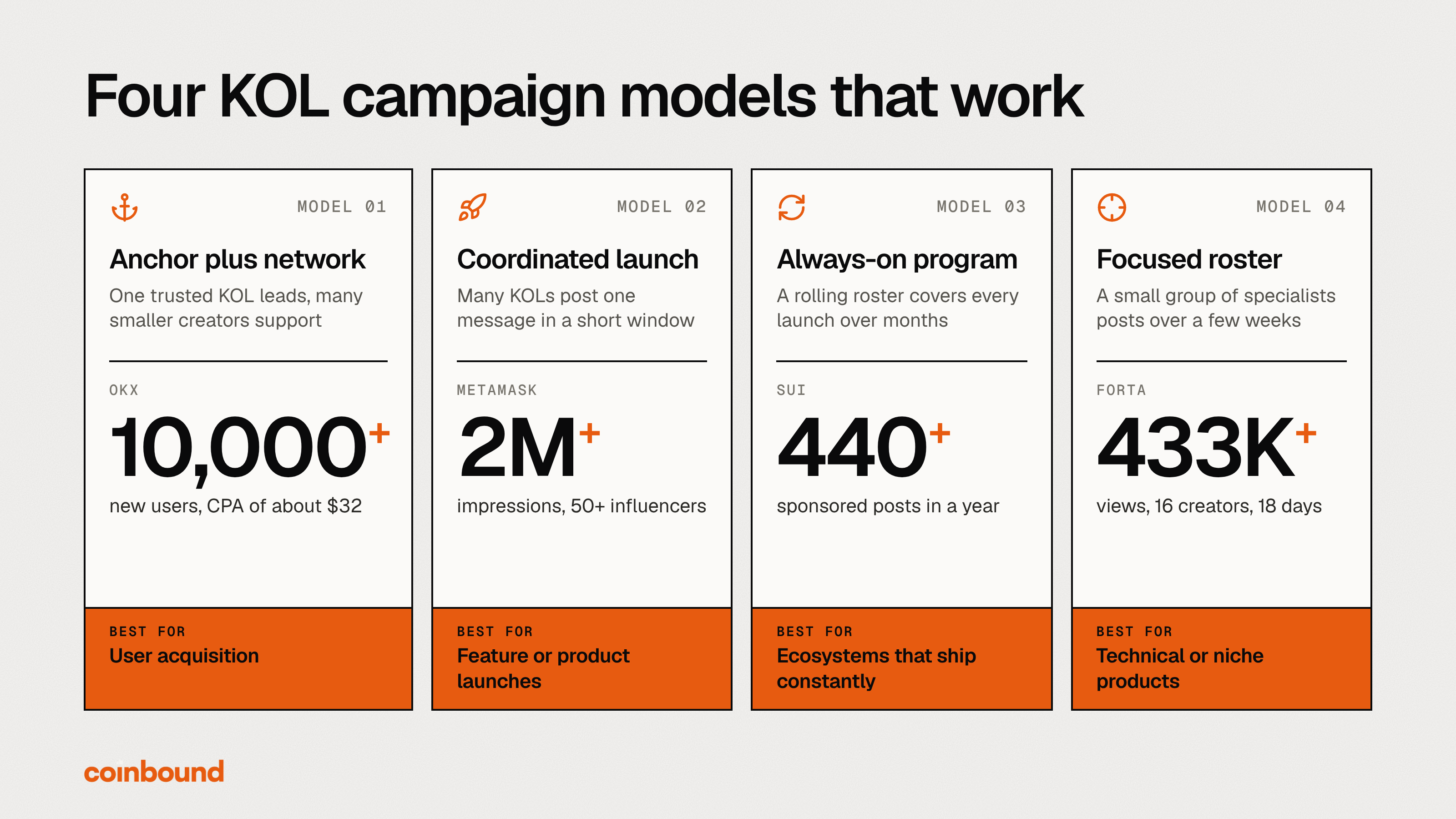
Most successful KOL marketing fits one of four models. Choosing the right one up front saves budget.
| Model | How it works | Best for | Example |
|---|---|---|---|
| Anchor plus network | One highly trusted KOL leads, supported by many smaller creators | User acquisition | OKX: 10,000+ new users at a CPA of about $32 |
| Coordinated launch | Many KOLs post one message in a short window | Feature or product launches | MetaMask: 2M+ impressions from 50+ influencers |
| Always-on program | A rolling roster covers every launch over months | Ecosystems that ship constantly | Sui: 440+ sponsored posts in a year |
| Focused roster | A small, curated group of specialists posts over a few weeks | Technical or niche products | Forta: 433K+ views from 16 creators in 18 days |
Anchor plus network. For OKX, Coinbound activated Ivan on Tech as the anchor creator and surrounded him with dozens of crypto YouTubers. Because the campaign was judged on activations, every creator was evaluated by the new users they drove. The result was more than 10,000 new users at a cost per acquisition of about $32.44.
Coordinated launch. MetaMask needed a new feature noticed inside an app its users already knew. More than 50 crypto influencers announced mobile swaps together, generating more than 2 million impressions.
Always-on program. Sui ships constantly, so a one-off campaign would not have worked. Coinbound ran Sui's influencer marketing for a year across launches including the Sui Wallet, DeepBook, SuiPlay, SuiNS, and Sui Basecamp, delivering 440+ sponsored posts and 5.8M+ views in the final three months alone.
Focused roster. Forta's security product needed credibility more than raw reach. Sixteen carefully chosen creators with a combined following of 2.3M+ generated 433,000+ views in 18 days.
How to Measure KOL Marketing
Views are the easiest number to report and the least useful on their own. Match your metrics to your goal.
- Awareness campaigns: views, impressions, and share of voice against competitors during the campaign window.
- Engagement and trust: replies, quote posts, and the quality of questions people ask, which show whether the audience understood the message.
- Acquisition campaigns: wallet connects, signups, deposits, and cost per acquisition, tracked with unique links or codes per KOL.
- Retention: whether users acquired through KOLs keep using the product after the campaign ends.
Our guide on how to measure ROI from a crypto influencer campaign walks through attribution setups in detail. The short version: decide what success means before the first post goes live, or you will end up defending a views number.
KOL Disclosure and Compliance
Paid KOL posts are advertising, and regulators treat them that way.
- United States. In 2022 the SEC charged Kim Kardashian for promoting EMAX tokens on Instagram without disclosing the $250,000 she was paid; she agreed to pay $1.26 million in penalties, disgorgement, and interest. The FTC's Endorsement Guides state that both the influencer and the advertiser may be liable if the influencer fails to clearly and conspicuously disclose being paid.
- United Kingdom. The FCA's finalised guidance on financial promotions on social media (FG24/1, March 2024) warns that unauthorised persons, such as influencers, who promote a regulated financial product without approval from an FCA-authorised person may be committing a criminal offence.
In practice, that means every brief should require a clear disclosure in the post itself, not buried in a bio, and every campaign should be reviewed for the markets it targets. Never ask KOLs to make price predictions or return promises about your token.
KOL Marketing Red Flags
Watch for these before you sign anyone:
- Engagement that does not match the following. Large accounts with little real conversation in the replies.
- Guaranteed price action. Any KOL or agency promising a pump is promising something you cannot legally or ethically buy.
- No disclosure. A KOL who refuses to label paid posts puts your brand at legal risk.
- A history of promoting failed projects. Scroll back through past sponsored posts and check what happened to those tokens.
- Copy-paste campaigns. If an agency plans to send identical text to every account, the audience will notice.
Running KOL Marketing In-House vs. With a KOL Marketing Agency
You can run KOL marketing yourself if you already have relationships, time to vet, and a way to track results. Most teams use a specialist for launches, because sourcing, negotiation, briefing, and reporting across dozens of creators is a full-time job. Here are the best options for crypto teams:
- Coinbound - The crypto marketing agency behind the campaigns in this guide. Coinbound has worked with 900+ Web3 brands since 2018, run 1,400+ campaigns, and works with a network of 800+ crypto creators across X, YouTube, TikTok, and Telegram. It handles strategy, sourcing, briefing, scheduling, and weekly reporting end to end. See our crypto influencer marketing services and case studies.
- Mintfunnel - A crypto marketing platform for the channels around a KOL campaign: native ads across 500+ crypto sites and press release distribution to 100+ outlets, with onchain attribution. Useful when you want coverage and paid reach to reinforce what KOLs are saying.
- Doing it in-house - Best for teams with a small, stable roster and an existing analytics setup. Expect to spend significant time on vetting and negotiation.
For a broader comparison of specialists, see our list of the best crypto influencer marketing agencies.
Frequently Asked Questions
What does KOL mean in marketing?
KOL means key opinion leader. In marketing, a KOL is a person whose expertise or track record makes their audience trust their opinion on a topic. Brands partner with KOLs to explain, recommend, or launch products to that audience.
What is the difference between a KOL and an influencer?
An influencer is valued mainly for reach and attention. A KOL is valued mainly for credibility and expertise in a specific field. In crypto, many accounts are both, and strong campaigns mix the two.
How much does KOL marketing cost?
Costs depend on the KOL's audience size, platform, format, and the number of posts. A single post from a niche DeFi writer costs far less than a dedicated YouTube video from a top educator. Most crypto teams budget per campaign rather than per post and judge results on cost per outcome, such as cost per new user.
Does KOL marketing still work on X after the InfoFi ban?
Yes. X's January 2026 policy change banned apps that reward users for posting, which ended incentivized "yapping" leaderboards. Direct, disclosed partnerships between brands and individual KOLs were not the target, and curated rosters are now the standard approach.
How do you measure the ROI of a KOL campaign?
Set the goal first, then track the matching metric: impressions for awareness, replies and quote posts for understanding, and signups, wallet connects, or deposits for acquisition. Unique links per KOL let you compare creators on cost per result.
Do crypto KOLs need to disclose paid posts?
Yes. In the U.S., the FTC's Endorsement Guides require clear disclosure of paid endorsements, and the SEC has charged promoters who failed to disclose payment for touting crypto assets. In the UK, the FCA warns that influencers promoting regulated financial products without authorised approval may be committing a criminal offence.
Start Your KOL Marketing Campaign
The best KOL marketing in 2027 looks less like buying attention and more like building a small group of credible advocates around one clear story. Start with the outcome you need, choose KOLs your audience already trusts, brief them on substance, and track every post.
If you are planning a launch or an always-on program, Coinbound can build the roster and run it end to end. Get a free proposal and we will map out which KOLs fit your audience and goals.