Web3 marketing is no longer experimental. The total crypto market capitalization surpassed the $4 trillion mark in 2025, retail adoption hit 741 million crypto owners globally, and institutional players from BlackRock to Franklin Templeton are actively building on-chain. The Global Web3 According to Emergen Research, the global Web3 (Web 3.0) market is projected to reach $81.5 billion by 2030 at a 43.7% CAGR.
What’s changed is who you’re marketing to and what they expect. The audience has expanded far beyond early crypto adopters: institutional decision-makers, TradFi professionals evaluating RWA tokenization, and mainstream users entering through DePIN, stablecoins, and crypto cards all require different messaging than the degen traders of previous cycles. At the same time, those crypto-native audiences have become far more sophisticated and far less tolerant of hype-driven marketing.
Web3 marketing in 2026 demands utility-first messaging, verifiable on-chain results, and genuine community alignment. The playbook has fundamentally shifted from “generate hype” to “demonstrate value.”
This guide covers everything you need to build an effective Web3 marketing operation in 2026, from understanding what makes Web3 marketing structurally different, to the specific strategies, tools, and channels that drive results.
Key takeaways
- Utility-first messaging is the new standard. Projects that lead with real use cases, yield data, and verifiable on-chain results outperform those still relying on speculation and hype.
- The audience has expanded, and splintered. You’re no longer marketing only to crypto-native degens. Institutional players, TradFi professionals evaluating RWAs, and mainstream users entering through stablecoins and DePIN all require different messaging.
- Community alignment beats paid reach. Token-based incentives and decentralized social platforms create acquisition loops that traditional paid media can’t replicate.
- On-chain attribution is changing measurement. Tools like Spindl, Formo, and Addressable are making it possible to trace spend from ad impression to wallet action, though the space is still maturing.
- New verticals require new playbooks. RWA tokenization, DePIN, and AI agents are creating entirely new marketing categories that demand specialized positioning.
- Regulatory clarity is an opportunity, not just a constraint. MiCA is in effect, US frameworks are taking shape; teams that build compliant marketing infrastructure now gain a first-mover advantage.
What is Web3 Marketing?
Web3 marketing is the practice of promoting products, protocols, and platforms within the decentralized internet ecosystem, using strategies built around community ownership, token economics, and on-chain transparency rather than centralized ad platforms and third-party data.
Unlike traditional digital marketing where you rent access to audiences through platforms like Google and Meta, Web3 marketing lets brands build direct, token-aligned relationships with their users. The fundamentals haven’t changed, you still need to reach the right people with the right message, but the tools, channels, incentive structures, and measurement frameworks are fundamentally different.
Here’s what makes Web3 marketing distinct in practice:
- Community as distribution: Your community isn’t just an audience; they’re stakeholders. Token holders, governance participants, and active contributors become your most effective marketing channel because they have real economic alignment with your success.
- Tokenomics as a marketing lever: Token incentives (airdrops, staking rewards, governance rights) create acquisition loops that don’t exist in Web2. Your marketing strategy and your token design are inseparable.
- On-chain attribution: For the first time, you can trace marketing spend all the way to on-chain conversions: wallet connections, token purchases, protocol deposits, governance votes. This level of attribution is impossible in traditional marketing.
- User-owned identity and data: Users control their own data through wallets and decentralized identifiers. You can’t target by scraping personal data; you earn attention through value, transparency, and community trust.
- Composable partnerships: The open, permissionless nature of Web3 means your product can integrate with others without gatekeepers. Partnership marketing becomes ecosystem marketing.
Partnering with a web3 marketing agency is one of the best ways to reach your desired audiences.
Also See: 10 Essential Web3 Marketing Tools Every Project Should Use
Key Features of Web3 Marketing
What separates web3 marketing from everything that came before it comes down to four structural shifts:
- Decentralization: In web3 digital marketing you skip the intermediaries and give users more control over their data and digital assets. It’s like buying directly from the source instead of going through multiple layers while ensuring users own their information.
- Tokenization: Tokenization is like turning digital actions into rewards. Brands might give users digital points or tokens for engaging with their content or participating in their community. Users own these tokens, which can represent various digital assets or rewards within the ecosystem, enhancing their control over their interactions and rewards.
- User Control: In Web3, you get to decide how your data is used, giving you even more control than adjusting privacy settings on social media. This emphasis on user control makes you feel more empowered and respected online, fostering trust and loyalty.
- Content Monetization: Web3 offers creators fresh ways to earn from their digital content, putting them in charge of how they make money. It’s like getting paid directly by your fans for what they love, all while ensuring they keep ownership of their contributions and interactions.
Difference Between Web 3.0 and Traditional Marketing
Web2 marketing relies on centralized platforms (like Facebook and Google) to target users based on data gathered by these companies, often leading to tailored ads but limited user control. Web3 marketing is aiming to give users ownership of their data and enabling brands to build trust directly within communities through transparent, peer-driven interactions.
In Web2, the customer acquisition funnel moves from awareness to conversion, with the platform capturing most of the value along the way. In Web3, tokens bootstrap new networks by bringing in early users and rewarding them for their contributions before network effects take hold, turning your earliest users into your most aligned marketing channel.
This also changes what you can measure. In a typical Web2 setup, attribution often stops at a form submission. With the right Web3 analytics stack, attribution can follow a user from an ad impression through wallet connection and on‑chain actions like token purchases, staking, or governance votes, unlocking end‑to‑end visibility that’s much harder to achieve in Web2. That said, identity fragmentation and multi‑wallet behavior still make Web3 attribution technically challenging.
| Web 3.0 Marketing | Traditional Marketing |
|---|---|
| Decentralized ownership and control by community members | Centralized ownership and control by businesses or organizations |
| Data is stored on decentralized networks with user consent | Data is stored centrally by businesses without user consent |
| Utilizes cryptocurrencies and tokenized economies for transactions | Relies on fiat currency and traditional payment methods |
| Accessible to a global audience without intermediaries | Access may be restricted or mediated by intermediaries |
| Community-driven moderation and governance mechanisms | Moderation typically controlled by platform administrators |
| Built on transparency and cryptographic trust mechanisms | Relies on reputation, brand trust, and legal frameworks |
| Encourages experimentation and innovation in decentralized ecosystems | Innovation may be limited by established industry norms |
| Diverse monetization options, including tokenized rewards and decentralized finance | Limited to traditional revenue streams such as advertising and product sales |
| Campaign attribution extends to on-chain conversions, wallet activity, and TVL | Attribution limited to clicks, impressions, and traditional CRM data |
| Subject to evolving regulatory frameworks like MiCA and emerging US legislation | Operates within established regulatory frameworks and industry standards |
What Does Web3 Buyer Persona Look Like?
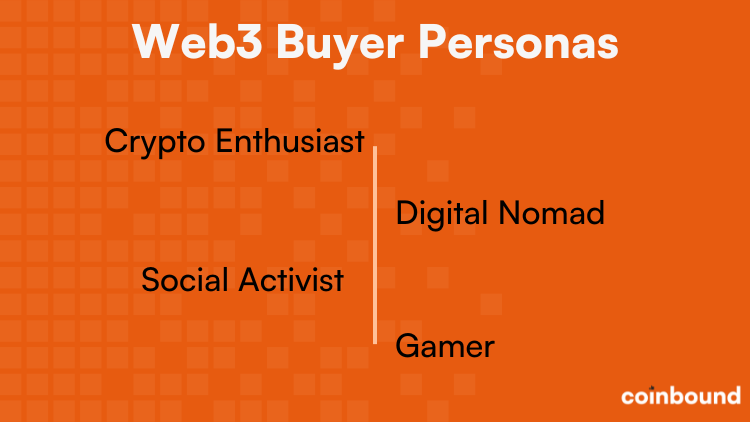
Here are some classic examples of Web3 buyer persona:
| Persona | Description |
|---|---|
| Crypto Enthusiast | Highly motivated by cryptocurrency and blockchain technology. Interested in decentralized finance (DeFi) and early adopters of new Web3 products and services. |
| Digital Nomad | Values freedom and flexibility in work and lifestyle. Interested in Web3 for its potential to enable remote work and earning income from anywhere in the world. |
| Social Activist | Motivated by social justice and environmental causes. Interested in Web3 for its potential to enable decentralized governance and community ownership. |
| Gamer | Interested in gaming and virtual worlds. Motivated by the potential to earn income and own assets in virtual worlds through NFTs and other Web3 technologies. |
| Institutional Decision-Maker | Enterprise executives, fund managers, and TradFi professionals evaluating tokenization, RWAs, and blockchain infrastructure. Motivated by yield, compliance, and operational efficiency, not ideology. Requires data-driven messaging and regulatory clarity. |
| DePIN Contributor | Individuals willing to deploy physical hardware (hotspots, GPUs, sensors) in exchange for token rewards. Motivated by passive income and participation in decentralized infrastructure networks like Helium or Render. |
For practical guidance on Web3 audiences check out our guide about Web3 audience research methods.
Why Does Your Business Need Web3 Digital Marketing?
The question has shifted from “should we try Web3 marketing?” to “can we afford not to?” Here’s why:
- Your competitors are already there. With $4 trillion in total crypto market cap and institutional heavyweights like BlackRock and Franklin Templeton building on-chain products, the window for being an “early mover” in Web3 is closing. Companies that establish brand authority now will own the narrative as adoption accelerates.
- Your audience is fragmenting across decentralized channels. Web3 users don’t live on Facebook and Instagram. They’re on Farcaster, Discord, Telegram, and X crypto communities. If your marketing strategy only covers Web2 channels, you’re invisible to an increasingly valuable audience segment.
- Token-aligned communities outperform traditional marketing. When users have economic alignment with your project through tokens, they become organic advocates. This creates acquisition and retention loops that are structurally impossible in Web2.
- On-chain data gives you better attribution than Web2. Blockchain-based analytics let you trace the full user journey from first touchpoint to on-chain action. This level of measurement and transparency makes every marketing dollar more accountable.
- Regulatory clarity is creating opportunity. With the EU’s MiCA framework now in effect and US crypto legislation taking shape, the regulatory fog that kept conservative players on the sidelines is lifting. Businesses that invest in compliant Web3 marketing infrastructure now will have a first-mover advantage as institutional capital continues to pour in.
- Smart contracts reduce operational overhead. Automated reward distribution, referral programs, loyalty mechanics, and partnership settlements through smart contracts mean faster execution and lower costs than manual Web2 equivalents.
- New verticals are opening up. RWA tokenization, DePIN, AI agents, and prediction markets are creating entirely new product categories that need marketing expertise. The agencies and teams that learn these verticals first will capture the demand.
The Role of AI and Blockchain in Web 3.0 Marketing
AI and blockchain are converging in ways that fundamentally change what marketers can do, and what audiences expect.
On the AI side, the shift is from tools that assist humans to agents that act independently. Agentic AI systems can now manage community channels, execute campaigns, and participate in governance without constant human oversight. This isn’t theoretical: projects are already deploying AI agents for 24/7 community management, personalized onboarding, and real-time sentiment monitoring across Discord and Telegram.
On the blockchain side, the shift is from opaque marketing to verifiable marketing. Every campaign interaction, ad impression, and conversion can potentially be recorded on-chain, creating a level of transparency and accountability that doesn’t exist in Web2. When your audience can verify your claims on a public ledger, trust isn’t just a marketing word. It’s infrastructure.
The intersection of both, sometimes labeled DeFAI, is where things get interesting. AI needs trust and payment rails to operate autonomously; blockchain provides them through decentralized identity, smart contracts, and on-chain audit trails. We cover the specific tools and tactics for putting this to work
Also see: From DeFi to DeFAI: How AI Is Transforming Decentralized Finance
Top Web3 Marketing Strategies For 2026
With this new iteration of the Internet, businesses need to adapt to Web3 to ensure open access and transparency. Now that we’ve covered what makes Web3 marketing different and why it matters, here are the specific strategies that are driving results in 2026.
1- Web3 and Crypto Content Marketing
In 2026, Web3 content marketing has shifted decisively from hype to utility. Audiences, especially institutional decision-makers entering through RWA tokenization and DePIN, are rejecting speculation-based messaging. The projects that win are the ones leading with case studies, verifiable on-chain data, and evidence-based claims rather than promises of future returns.
Content formats are evolving too. Short-form video and livestream remain extremely effective; many projects are testing short educational videos and live AMAs to interact with communities in real time. There’s also a “de-filtering” trend: in an era where anyone can generate polished AI copy, audiences actually prefer content with authentic imperfections. Encourage community members and KOCs (Key Opinion Consumers) to share raw, everyday experiences rather than overproduced assets.
Consider adding Generative Engine Optimization (GEO) to your content strategy. As AI-powered search (ChatGPT, Perplexity, Google AI Overviews) increasingly answers user queries directly, creating clear, authoritative content that these models can easily parse and cite will become as important as traditional SEO.
Also see: Creating a Winning Web3 Content Marketing Strategy in 7 Steps
2- Social Media That Embraces Decentralization
Your Web3 audience isn’t on Instagram. They’re scrolling Farcaster, debating in Discord, and sharing alpha on Crypto Twitter. Your Web3 social strategy needs to meet them there.
What to prioritize: Post natively on decentralized social, not just cross-post from X. Each decentralized platform has its own culture and features. On Farcaster, use Frames to let users mint, vote, or interact with your product directly in-feed. On Mirror, publish long-form thought leadership that lives permanently on-chain. On Discord and Telegram, run structured AMAs and governance discussions that give your community real input, not just the illusion of it.
What separates good Web3 social from bad: consistency and genuine interaction. Most projects launch with a burst of posts, then go quiet for weeks. The ones that build lasting communities show up daily, respond to comments, amplify community-created content, and give token holders meaningful ways to participate, whether that’s content curation, proposal voting, or ambassador programs with on-chain rewards.
The decentralized social landscape has evolved significantly: the platforms that dominated earlier Web3 cycles have largely been replaced by newer protocols with stronger ecosystems.
For a full breakdown of which platforms matter now and how to use them, see our guide: Top Web3 Social Media Platforms.
3- Leverage AI-Powered Marketing and On-Chain Analytics
The convergence of AI and blockchain, sometimes called DeFAI, is one of the most consequential shifts in Web3 marketing for 2026. Here’s how to put it to work:
Use on-chain analytics for campaign attribution.
Traditional marketing metrics (clicks, impressions, CPM) don’t tell you much in Web3: what matters is what happens after someone connects their wallet. A new category of on-chain attribution tools is emerging to bridge this gap, though it’s still a maturing space:
- Dune: flexible SQL dashboards for custom on-chain queries. More technical, usually paired with other tools for full attribution.
- Spindl: connects ad impressions to on-chain actions (swaps, mints, staking). The ad-to-wallet pipeline Web2 marketers take for granted.
- Formo: unified product, web, and blockchain analytics. Tracks user journeys from first click to on-chain transaction across 40+ chains.
- Addressable: wallet-level audience targeting based on token holdings, protocol usage, and transaction patterns.
Deploy AI for community management at scale.
AI agents can now handle first-line community engagement, answer FAQs, moderate Discord and Telegram channels, and even facilitate onboarding flows. In 2026, more projects are using agentic AI to maintain 24/7 community presence without burning out their human teams.
Personalize outreach with wallet intelligence.
Wallet intelligence platforms turn anonymous wallet addresses into user profiles by analyzing on-chain activity. This means you can personalize messaging based on token holdings, protocol interactions, and transaction history, a level of targeting that’s impossible in traditional marketing.
Track the metrics that matter.
Shift from vanity metrics to meaningful ones: on-chain conversions, TVL contributions, governance participation, and token velocity. When evaluating influencer or content campaigns, measure how many wallets connected, how much was staked or deposited, and how many users returned after 30 days, not just views and likes.
4- Cultivate a Dynamic Web3 Community
Community management in Web3 is your product’s immune system, sales team, and feedback loop rolled into one. Token holders who feel genuine ownership will defend your project during downturns, onboard new users, and surface problems before they become crises. No paid campaign replicates that.
- Start with structure. Set up your core channels (Discord, Telegram, Farcaster) with clear purposes for each: don’t just open a Discord and hope for the best. Define what happens in each space: product feedback here, governance discussion there, general chat somewhere else.
- Use token-gating to create tiered experiences. Tools like Guild.xyz let you gate channels, content, and governance access based on token or NFT holdings. This creates real incentive for deeper participation: holders unlock more value as their commitment increases. It also filters out bots and noise.
- Let the community lead. The strongest Web3 communities run their own campaigns, sub-groups, and proposals. Give members the frameworks and resources to self-organize (ambassador programs, content bounties, regional chapters) rather than trying to control every conversation from the top down.
- Be transparent, especially when things go wrong. Your community can verify everything on-chain. Astroturfed engagement, inflated metrics, and ignored governance votes get exposed fast and damage credibility permanently. Share roadmap updates honestly, address criticism directly, and use on-chain governance (snapshot votes, token-weighted proposals) to give members real decision-making power, not just the appearance of it.
For detailed strategies check out our Web3 Community Management Guide.

5- Generate Positive Media Coverage with Web3 PR
Earned media is one of the strongest trust signals in crypto. When a credible outlet covers your project, not because you paid for it, but because the story was worth telling, it carries more weight with investors, partners, and users than any ad campaign.
- Build relationships before you need them. The biggest mistake in crypto PR is only reaching out to journalists when you have something to announce. Start by offering genuine value (insights, data, expert commentary on industry trends) so when your launch day arrives, you’re a known quantity, not a cold pitch in an inbox of 200.
- Lead with the story, not the product. Reporters cover narratives, not feature lists. Frame your announcement around a broader industry trend: “RWA tokenization hits $18B” is a story. “We launched a new token” is not. Position your team as expert sources on the trend, with your product as proof of the thesis.
- Distribute through the right channels. Crypto-focused distribution services like Mintfunnel guarantee placement on outlets your audience actually reads (CoinTelegraph, CoinMarketCap, BeInCrypto, Benzinga) rather than generic newswires where crypto news gets buried. For maximum impact, amplify published coverage through crypto ad networks to put it in front of targeted Web3 audiences.
- Distribute through the right channels. Crypto-focused distribution services like Mintfunnel guarantee placement on outlets your audience actually reads (CoinTelegraph, CoinMarketCap, BeInCrypto, Benzinga) rather than generic newswires where crypto news gets buried. Mintfunnel caters to all types of Web3 companies, from NFT collections and token sales to DeFi platforms and L1/L2 launches.
- Amplify coverage with crypto ad networks. Web3 PR builds credibility through earned media, but the reach often stops at the publication’s audience. A crypto ad network let you promote published press releases, interviews, and thought leadership pieces via native ads, putting your coverage in front of targeted Web3 audiences who didn’t see it organically. This turns a single media placement into a sustained visibility campaign.
- Have a PR crisis plan before you need one. Security breaches, regulatory scrutiny, community backlash: these aren’t hypotheticals in crypto. A prepared team with a clear response framework and established media relationships can control a narrative in hours. An unprepared team loses it permanently.
- Position leadership as thought leaders. Encourage your founders and execs to contribute op-eds, join panels, and offer expert commentary. Consistent, informed public presence builds long-term credibility that no single press release can match.
For ready-to-use templates and checklists, see our Crypto PR Toolkit. If you’re planning a token launch specifically, our Crypto PR Strategies for Successful Token Launches breaks down the full playbook.
6- Partner With Crypto Influencers

The influencer landscape in Web3 has matured significantly. In 2026, the most effective influencer marketing approach combines KOLs (Key Opinion Leaders) for reach and authority with KOCs (Key Opinion Consumers) for grassroots trust and conversion. KOCs (everyday users with smaller but highly engaged followings) often drive more actual adoption than mega-influencers because their endorsements feel authentic.
Successful projects now match creators to specific strategic objectives: awareness campaigns require different creator expertise than conversion campaigns. Long-term creator relationships build compounding credibility, while one-off promotions rarely move the needle. Track meaningful metrics: engagement, wallet connections, and community growth, not just views. And invest in multi-platform strategies: YouTube for depth, X/Twitter for reach, TikTok and short-form video for onboarding a new generation of crypto users.
Also see: Top Crypto KOLs to Follow
7- Web3 Search Engine Optimization
The fundamentals of SEO haven’t changed, but where and how people search for Web3 products has. An increasing share of discovery is shifting to AI-powered search (ChatGPT, Perplexity, Google AI Overviews) which means your content strategy needs to account for Generative Engine Optimization (GEO) alongside traditional SEO. Structure content with clear definitions, direct answers, comparison tables, and structured data so AI models can parse, cite, and recommend your pages.
For a full breakdown of Web3 SEO strategy, see this guide.
8- Use PPC Advertising
Beyond traditional PPC platforms, consider blockchain-native ad networks that offer on-chain verifiable impressions and transparent attribution. These networks reduce ad fraud, a persistent problem in digital advertising, and let you target users based on wallet holdings and on-chain behavior, not just browsing cookies.
For retargeting, the game has changed. Cookie-based retargeting is declining; instead, use wallet-based retargeting to re-engage users who previously connected their wallet to your dApp or interacted with your smart contracts. This is a far more intent-rich signal than a page visit.
For more details see our crypto advertising guide: Crypto Ad Network vs Google Ads for Crypto: Choosing the Right Channel for ROAS, Compliance, and Scale
9- Build Partnerships
Creating partnerships and collaborations is a powerful strategy for Web3 marketing that many Web3 marketing agencies use for fostering community, expanding reach, and building credibility. Here are key considerations for establishing partnerships in the Web3 space:
- Identify Synergistic Partners: Look for businesses, projects, or influencers in the Web3 ecosystem that share common values and goals. Seek partnerships that bring complementary strengths in technology, user base, or expertise.
- Do Cross-Promotions: Collaborate on cross-promotional activities. This could include joint marketing campaigns, co-branded content, or mutual endorsements. You can extend your reach within the Web3 community by leveraging each other’s audiences.
- Build Strategic Alliances: Form strategic alliances with projects or platforms that align with your Web3 business objectives. This could involve integrating your services with theirs, creating interoperable solutions, or jointly developing new features to enhance the overall user experience.
- Do Open-Source Collaboration: Contribute to or collaborate on open-source projects within the Web3 space. This showcases your expertise and establishes your Web3 business as a collaborative player in the community.
- Organize Hackathons and Competitions: Host or participate in hackathons, coding competitions, or challenges within the Web3 developer community. This can attract talent, foster innovation, and create opportunities for collaboration with developers and other businesses.
- Host Webinars: Collaborate on educational initiatives such as webinars, workshops, or online courses. Sharing knowledge and expertise with your partners can establish both organizations as leaders in the Web3 space.
- Participate or Host Joint Events and Conferences: Co-host or participate in conferences. This can include panel discussions, joint booths, or shared sponsorship opportunities. Collaborative presence at industry events enhances visibility and credibility.
10- Tokens and Airdrops
“In Web3, ownership and control is decentralized. Users and builders can own pieces of internet services by owning tokens, both non-fungible (NFTs) and fungible,” said Web3 investor Chris Dixon.
In crypto, there have been many successful cases of airdrops such as Uniswap (UNI), Bored Ape Yacht Club (APECoin), Looks Rare, and Ethereum Name Services (ENS).
Airdrop strategy has matured considerably since the early days. In 2026, the most effective airdrop campaigns are moving toward “fairer launches”, rewarding genuine protocol usage and contribution rather than wallet farming. Projects are implementing Sybil-resistance mechanisms to filter out bot activity and ensure tokens reach real users who will participate in governance and long-term ecosystem growth.
Bounty campaigns, where community members earn tokens or NFTs for specific contributions like content creation, bug reporting, social sharing, or translation, remain a cost-effective way to bootstrap community involvement while creating authentic user-generated content.
11- RWA Marketing and DePIN
Two of the most significant Web3 narratives heading into 2026 are Real-World Asset (RWA) tokenization and Decentralized Physical Infrastructure Networks (DePIN). Both require fundamentally different marketing approaches than traditional crypto projects.
RWA tokenization is bringing traditional finance onto the blockchain. On-chain tokenized RWAs surged from roughly $5.5 billion to approximately $18.6 billion over 2025.
Marketing RWA projects requires a completely different playbook from typical crypto marketing. Price speculation, memes, and “to the moon” rhetoric don’t work here. RWA audiences (institutional investors, family offices, and sophisticated retail participants) care about yield, liquidity, regulatory compliance, and risk management. Lead with data: how much yield, what’s the underlying asset, what regulatory framework applies, and how does liquidity work. Think whitepapers, investor decks, and webinars over Twitter threads and Discord hype.
DePIN projects represent one of Web3’s most compelling value propositions: real people contributing real physical infrastructure (wireless networks, compute power, storage, sensors, energy) and earning real rewards. The DePIN market is valued at approximately $30 billion with over 1,500 active projects.
DePIN marketing is fundamentally about mobilization. You need thousands of individual participants deploying hardware and contributing resources. Your content needs to make ordinary people understand why they should buy a hotspot, contribute bandwidth, or deploy a sensor in their neighborhood. Structure multi-phase content campaigns: awareness content introducing the project, educational content explaining participation, tutorial content walking through hardware setup, and ongoing content showcasing community growth and earnings data.
12- Email and Wallet-Based Marketing
Email marketing remains a high-ROI channel for Web3 projects, but the landscape is evolving. Here’s how to make it work in 2026:
- Build your email list from people who are interested in Web3, cryptocurrencies, and related topics. Use lead magnets like research reports, token analysis, or exclusive community access to drive sign-ups.
- Send personalized emails that speak to your audience’s specific Web3 interests. Tell subscribers about product features, updates, and special offers. Segment your list based on user behavior and engagement level.
- Gamify and add rewards. Make your emails more engaging by including token rewards, NFT giveaways, or exclusive access. This encourages open rates, click-throughs, and long-term retention.
- Extend into wallet-based messaging. The most forward-thinking Web3 projects are now complementing email with wallet-based communication, sending targeted messages and notifications directly to users’ wallets based on their on-chain activity. Demographic targeting expands to include token holdings. Campaign attribution extends to on-chain conversions. This creates unified user journeys spanning Web2 and Web3 touchpoints.
- Segment users based on both traditional demographics and on-chain behavior. Target DeFi power users differently from NFT collectors. Personalize messaging based on wallet holdings and protocol interactions. Measure success by on-chain metrics, not just opens and clicks.
13- Referral Programs
Referral programs encourage users to spread the word and bring new audiences into a platform or network. This happens by offering rewards, often in tokens or other perks, for successful referrals. It’s like turning your satisfied users into ambassadors who share their positive experiences with others.
Blockchain and Web3 referral programs utilize the power of word-of-mouth marketing to grow user bases and community engagement. They can work through various channels like social media, emails, or direct messages, and are flexible enough to fit the unique dynamics of the Web3 world.
Ultimately, effective referral programs help Web3 projects leverage the network effects of decentralized systems, speeding up adoption and nurturing lively communities around their offerings.
Also see: Top Crypto Affiliate Programs
Conclusion
Web3 marketing in 2026 is defined by a shift from speculation to substance. The audience now spans crypto-native users, institutional players, and mainstream adopters, each requiring different messaging, channels, and proof points. The projects that win are the ones that communicate real value backed by on-chain data, genuine community engagement, and clear use cases.
The playbook is evolving fast: new verticals like RWAs and DePIN, new tools for on-chain attribution, new channels like Farcaster, and the growing impact of AI on both campaign execution and search discovery. Staying adaptive without chasing every trend is the balance every Web3 marketing team needs to strike.
Coinbound is a lading Web3 marketing agency, who has helped 900+ Web3 brands (including Gala, Immutable, eToro, MetaMask, and Sui) build and execute marketing strategies that deliver measurable results. Whether you need crypto PR, influencer campaigns, community management, or a full go-to-market strategy, get in touch for a proposal.
FAQs About Web3 Marketing
What is Web 3.0?
Web 3.0 is the current era of the internet built on blockchain technology, decentralization, and user ownership. Unlike previous eras where platforms controlled user data and content, Web3 gives users direct ownership of their digital assets, identity, and interactions through wallets, tokens, and smart contracts.
| Feature | Web 1.0 | Web 2.0 | Web 3.0 |
|---|---|---|---|
| Era | Early 1990s – early 2000s | Mid-2000s – present | ~2017 – present |
| Interaction | Static web pages (read-only) | Dynamic, social platforms (read-write) | Decentralized, user-owned (read-write-own) |
| User Role | Passive consumers | Active participants and content creators | Owners and stakeholders |
| Content | Text and images published by webmasters | User-generated (posts, videos, reviews) | User-owned, token-gated, on-chain publishing |
| Core Technologies | HTML, CSS | AJAX, cloud computing, mobile apps | Blockchain, smart contracts, wallets, tokens |
| Data Control | Website owners | Platforms (Google, Meta, Amazon) | Users (via wallets and private keys) |
| Examples | Yahoo, early corporate websites | Facebook, YouTube, Instagram, Wikipedia | Uniswap, MetaMask, Farcaster, OpenSea, Aave |
| Business Model | Banner ads, portals | Targeted ads, data monetization | Token economies, protocol fees, community ownership |
| Focus | Information access | Social connection and collaboration | Ownership, transparency, and decentralized value exchange |
What Do Web3 Marketing Services Offer?
Web3 marketing companies offer the following:
- RWA and DePIN Go-to-Market Strategy
- Tokenomics Consulting and Airdrop Strategy
- KOL and Influencer Campaigns
- Web3 PR
- PPC Advertising
- Social Media Marketing
- UX-Friendly Website and dApp Design
- Web3 Community Management & Engagement
- Content Copywriting
- Content Marketing
- AI-driven Predictive Analytics
- Automated Customer Support and Chatbot Solutions
How is Web3 marketing different from traditional digital marketing?
The core difference is structural. Web2 marketing rents audiences from centralized platforms like Google and Meta. Web3 marketing builds direct, token-aligned relationships with users through communities, wallets, and on-chain transparency. Key differences include: users own their data and identity (no third-party cookie targeting), token incentives create acquisition loops impossible in Web2, community members are stakeholders not just customers, and campaign attribution can follow users all the way to on-chain actions like staking, swapping, or governance votes.
How much does Web3 marketing cost?
It depends on scope, channels, and goals. A focused campaign (e.g., PR around a token launch or a short influencer push) can start in the low thousands. Comprehensive retainers covering PR, influencer, community, SEO, and content typically range higher depending on the project’s stage and ambition. The best approach is to request a custom proposal based on your specific needs; most reputable agencies will scope and price based on your goals rather than offering one-size-fits-all packages.