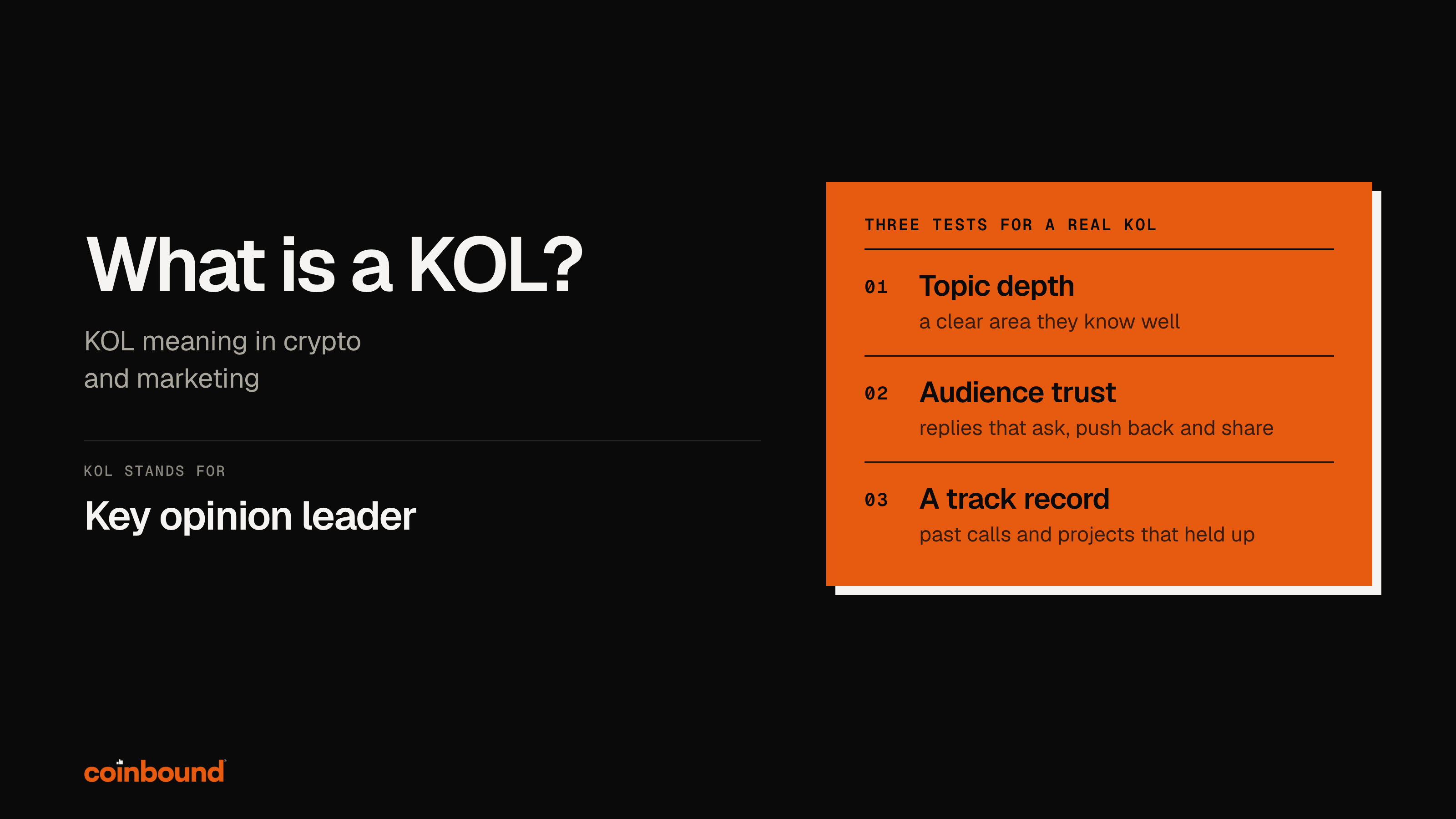
A KOL is a key opinion leader: a person whose knowledge of a topic makes other people trust their judgment on it. In crypto, KOLs are the traders, researchers, educators, builders and community leaders on X, YouTube and Telegram whose takes shape how their followers think about a token, protocol or app. In marketing more broadly, a KOL is an expert voice a brand partners with to explain or recommend its product.
The short version of the KOL meaning: an influencer is defined by reach, while a KOL is defined by credibility. Plenty of people are both, but the difference decides who you should listen to as a reader, and who you should hire as a brand.
At Coinbound we have worked with 900+ crypto and Web3 clients, and we have built KOL rosters for launches at OKX, MetaMask, Sui and Walrus. This guide explains what KOL stands for, where the term comes from, what it means in crypto specifically, how KOLs get paid, and how to tell a real KOL from an account that just posts a lot.
What Does KOL Stand For?
KOL stands for key opinion leader. You will see it written three ways:
- KOL (singular): one person, for example "a DeFi KOL".
- KOLs (plural): a group of them, for example "we booked 16 KOLs for the launch".
- KOL marketing: the practice of partnering with KOLs to promote or explain a product. Our full KOL marketing guide covers how campaigns are planned and run.
The word that does the work is "opinion". A KOL is not valuable because many people see their posts. A KOL is valuable because the people who see their posts change what they believe, buy or build after reading them.
Where the Term KOL Comes From
The idea is older than social media. In 1955, sociologists Elihu Katz and Paul Lazarsfeld published Personal Influence, which described a two-step flow of communication: most people do not form opinions straight from mass media, but from "opinion leaders" who interpret media messages and put them into context for everyone else. Opinion leadership became a standard concept for explaining how new ideas and products spread.
The "key" version of the phrase took hold in healthcare. Definitive Healthcare describes a key opinion leader as a trusted, well-respected influencer with proven experience and expertise in a field, such as a physician, researcher or health system director. Pharmaceutical and medical device companies consult these experts on everything from clinical trial design to go-to-market messaging, because doctors listen to other respected doctors.
Crypto borrowed the term because it describes the same dynamic. A new protocol is hard to evaluate from the outside, so people look to someone they already trust to tell them whether it is worth their attention.
| Context | Who counts as a KOL | What they influence |
|---|---|---|
| Healthcare | Physicians, researchers, health system leaders | Treatment choices, trial design, hospital buying |
| Brand marketing | Experts and respected creators in a niche | What their audience buys or tries next |
| Crypto | Traders, researchers, educators, builders, community leaders | Which tokens, protocols and apps get attention |
What Is a KOL in Crypto?
In crypto, a KOL is anyone whose public analysis or commentary reliably moves what a crypto audience pays attention to. That includes:
- Market commentators. Traders and macro voices with large followings. On our Sui program, this tier included voices such as Altcoin Gordon, Rekt Capital and Paul Barron.
- Researchers and educators. Thread writers and analysts who explain how a protocol works. The DeFi Edge played this role on both our Sui and Walrus campaigns.
- YouTube educators. Long-form creators who walk viewers through a product. For OKX, Coinbound built the campaign around Ivan on Tech, one of the most recognized educational voices in crypto.
- Builders and founders. Developers whose opinion signals technical credibility to other builders.
- Community leaders. Telegram and Discord admins whose groups take their lead on what to discuss.
- Regional voices. Creators who speak to one language or market. The Walrus campaign included a Turkish-language creator to reach an audience the English roster could not.
What ties these together is influence over decisions, not follower count. A researcher with 30,000 engaged followers can matter more to a DeFi protocol than a personality with ten times the audience and no connection to the topic. If you want names, our list of top crypto KOLs to follow covers voices crypto audiences watch today.
Why KOLs carry so much weight in crypto
Crypto audiences do their own research before they connect a wallet, and KOLs are a big part of that research loop. CoinDesk reported that market intelligence firm The Tie found "significant and positive token movements" in the hours after posts from 310 influencers about the top 175 cryptocurrencies over a 90-day window. When a group of opinion leaders can move attention that quickly, projects naturally compete to work with them.
KOL vs. Influencer: What Is the Difference?
Every KOL is an influencer in the loose sense, but not every influencer is a KOL. The practical difference comes down to what the audience is buying when they follow someone.
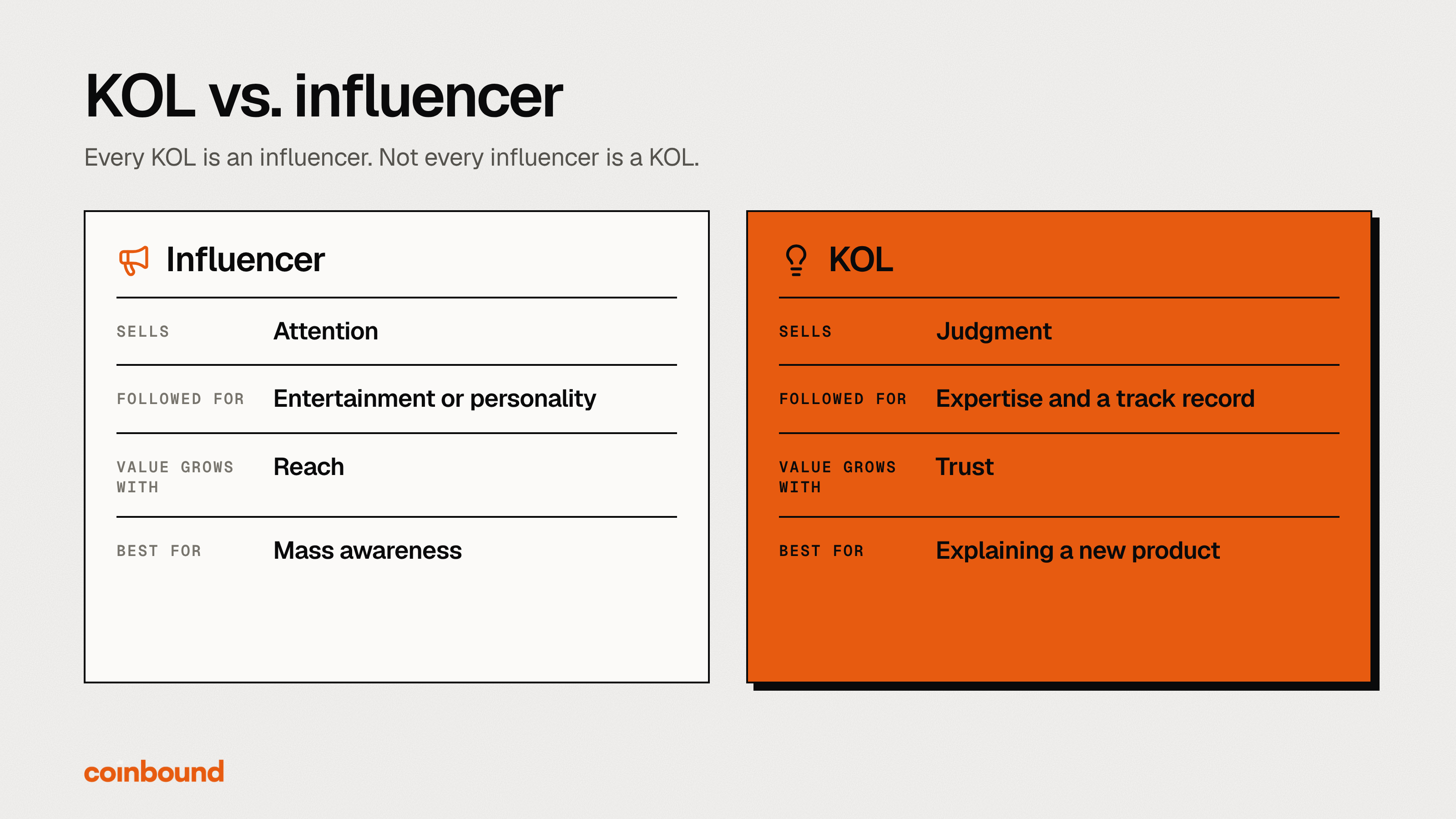
- An influencer sells attention. People follow them for entertainment, lifestyle or personality. A post creates awareness.
- A KOL sells judgment. People follow them because they have been right before, or because they explain things well. A post changes what the audience thinks.
- An influencer's value scales with reach. Twice the followers usually means roughly twice the impressions.
- A KOL's value scales with trust. A small, highly technical audience can be worth more than a big general one if those readers are the ones who deposit, build or vote.
In crypto the line blurs fast, because many large accounts are also respected analysts. That is why the best campaigns mix both: larger accounts for reach, specialists for credibility. On our Forta campaign, for a real-time threat-detection network for Web3, Coinbound built a roster of 16 creators on X that included DeFi researchers, thread writers, ecosystem news accounts and larger crypto personalities. The 16 posts generated more than 433,000 views in 18 days.
What Makes Someone a Real KOL
Anyone can call themselves a KOL in a bio. Before we put anyone on a client roster, we look for three things.
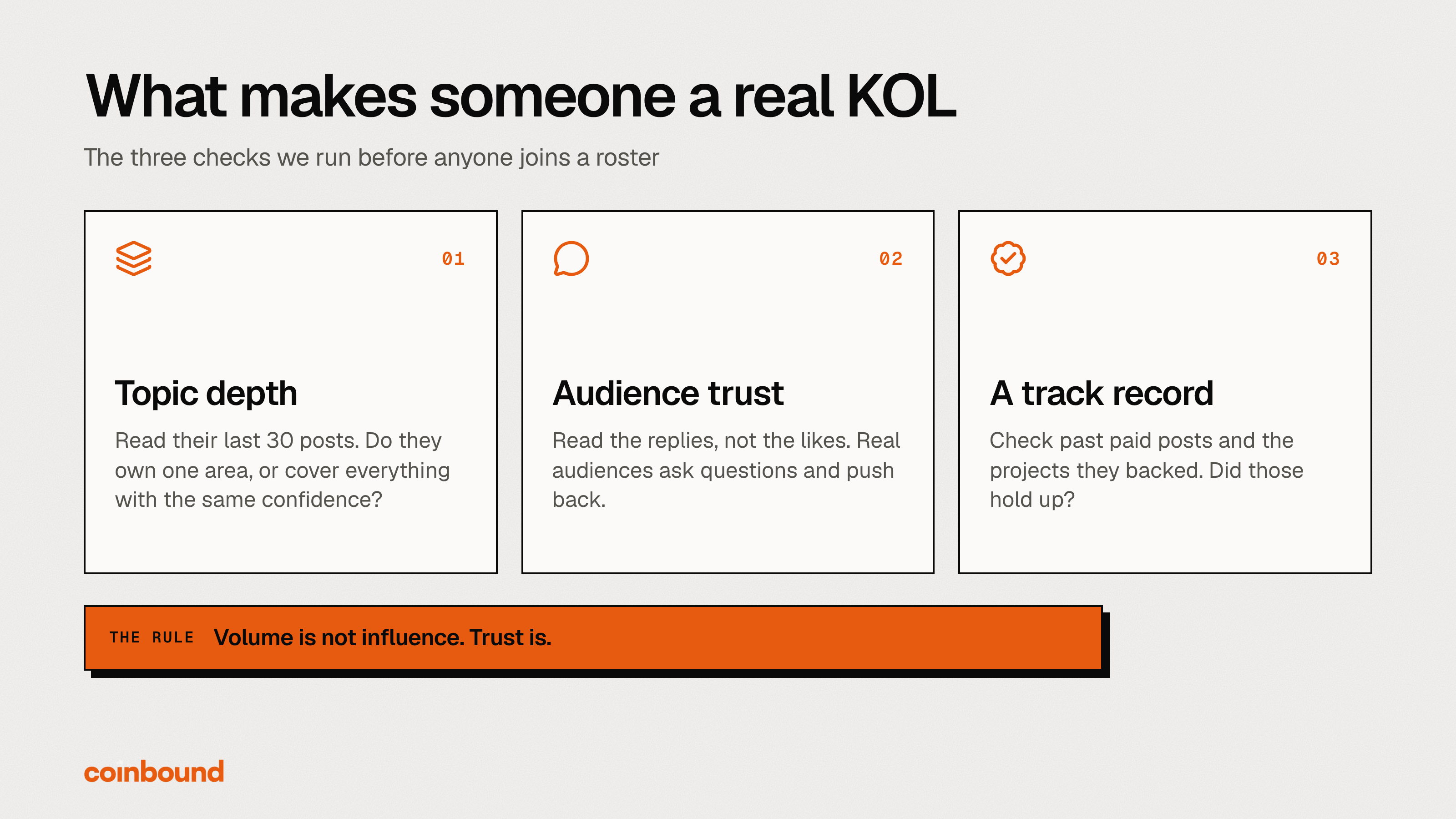
1. Topic depth
A real KOL has a clear area they know well, such as DeFi, L2s, gaming, wallets or a specific ecosystem. Read their last 30 posts. If they cover everything from memecoins to macro to AI with the same confidence, they are a commentator, not an expert, and that is fine for reach but not for credibility.
2. Audience trust
Look at the replies, not the likes. Real audiences ask questions, push back and share their own takes. Bot-heavy or farmed audiences leave emojis, generic praise and the same three phrases over and over. Check where the audience is located, too. A KOL with mostly Turkish or Korean followers can be perfect or useless depending on the market you need.
3. A track record
Scroll back through past paid posts and the projects the KOL has backed. Did those projects hold up? Did the KOL explain what the product does, or just post a ticker with a rocket emoji? KOLs who have repeatedly pushed projects that later collapsed have spent the trust that made them worth hiring.
The 2026 lesson: volume is not influence
The clearest recent proof came from X itself. On January 15, 2026, CoinDesk reported that X head of product Nikita Bier said the platform would no longer allow apps that pay users to post, citing a surge in "AI slop & reply spam." Kaito said it would sunset its Yaps product, the Kaito Yapper community of roughly 157,000 members was banned on X, and Kaito moved to a more selective, tier-based creator platform. Thousands of accounts posting for points were never KOLs in the real sense. The people who survive changes like that are the ones audiences chose to follow on purpose.
How Crypto KOLs Get Paid
There are three common ways a project works with a KOL, and knowing which one you are looking at tells you a lot about the post in front of you.
- Sponsored content. The project or its agency pays a fee for a specific deliverable: a thread, a video, a livestream segment or an AMA. This is the simplest model to measure, because every post can be tracked.
- Ambassador or always-on programs. A KOL works with a project over months instead of one post. For Sui, Coinbound ran a year-long creator program that delivered more than 440 sponsored posts across the network and launches such as the Sui Wallet and SuiPlay.
- KOL rounds. Some token projects let KOLs invest before launch. According to CoinDesk's investigation of the KOL economy, KOLs in these rounds often get discounted valuations and the option to sell tokens sooner than other early investors, sometimes as soon as the token launches.
Our view is simple: pay KOLs for work, and judge them on the work. Paid, tracked content keeps everyone's incentives pointed at the same goal, which is an audience that understands the product. When a KOL's main reward depends on the token price in the first week, their content tends to follow the price, not the product.
The Main KOL Tiers Brands Use
Follower count still matters, but we find it more useful to sort KOLs by the job they do on a campaign. Here is the working model we use when we build a roster.
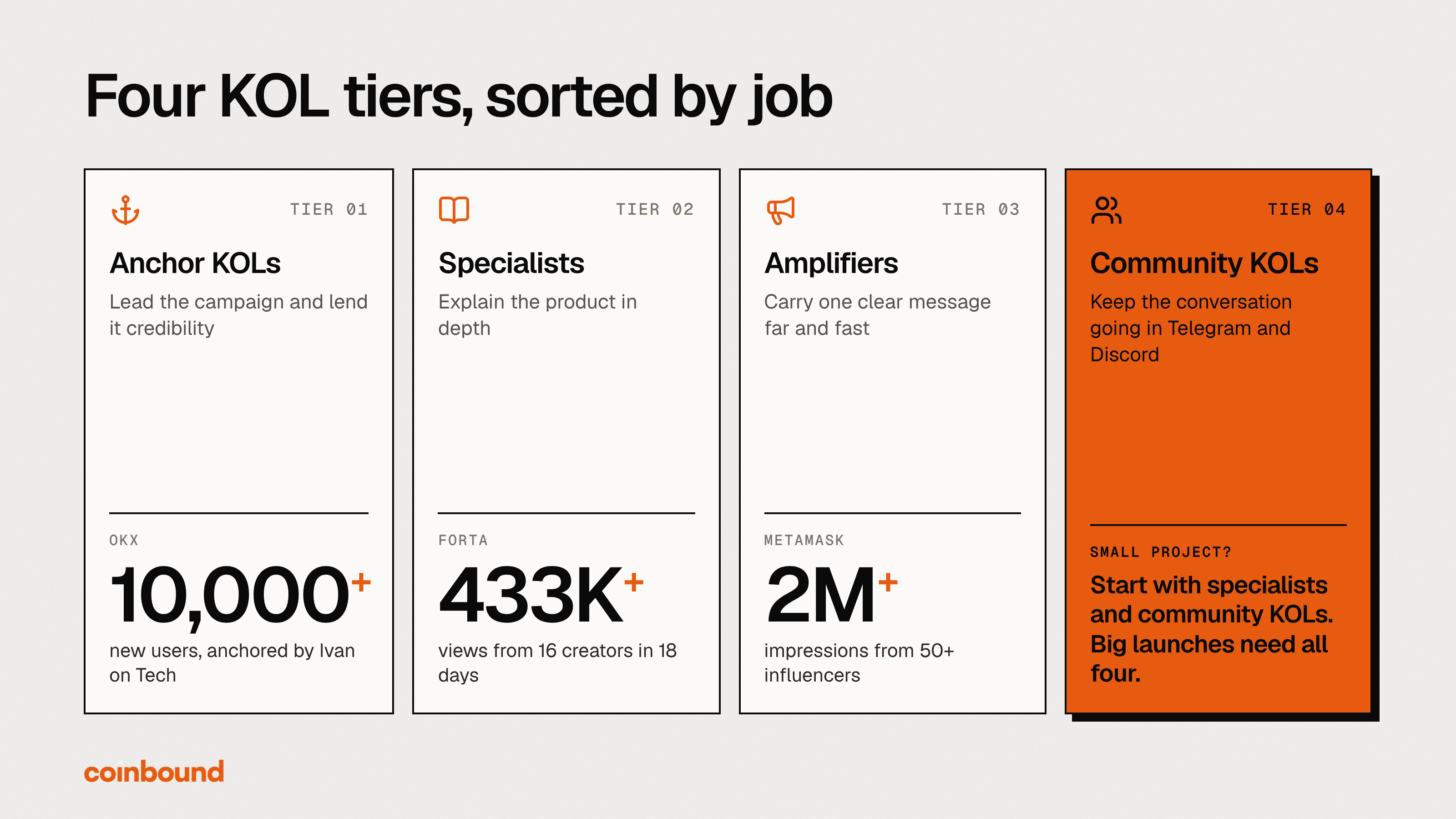
- Anchor KOLs. One or two trusted names who lead the campaign and give it credibility. For OKX, Ivan on Tech anchored a campaign supported by dozens of other crypto YouTube creators. It activated more than 10,000 new users at a cost per acquisition of about $32.44, according to our OKX case study.
- Specialists. Researchers and educators who explain the product in depth. They do the trust-building work that makes everything else land. On Forta, DeFi-focused writers and news accounts added context and credibility while larger accounts carried reach.
- Amplifiers. Larger accounts and news accounts that carry one clear message far and fast. For the MetaMask mobile swaps launch, Coinbound activated more than 50 crypto influencers who carried the same core message, generating more than 2 million impressions.
- Community KOLs. Telegram and Discord leaders who keep the conversation going after the posts go out.
A small project might only need specialists and a few community KOLs. A major launch usually needs all four.
How to Find KOLs in Your Niche
If you are a project looking for the right voices, start with your audience, not a list of famous accounts.
- Write down who needs to believe your story. Traders, DeFi users, developers, gamers and long-term holders follow very different people.
- Search the conversations they already have. Look at who gets quoted, replied to and bookmarked when your category comes up on X, YouTube and Telegram.
- Check who your competitors and peers worked with. Then check how those posts performed, not just whether they happened.
- Shortlist, then vet. Run every name through the three tests above before you talk price.
- Start with a small paid test. One or two posts per KOL will tell you more than any media kit.
If you would rather not build this from scratch, our crypto influencer marketing team runs sourcing, vetting, briefing and reporting end to end. Coinbound is a leading crypto marketing agency with 900+ clients, from exchanges and wallets to L1s and storage protocols, and KOL campaigns are a core part of that work.
How to Become a KOL in Crypto
The same three tests apply in reverse. If you want to become a crypto KOL:
- Pick a lane. Own a topic, such as a single ecosystem, DeFi mechanics, on-chain data or token launches.
- Explain, do not just predict. Threads that teach how something works build trust faster than price calls.
- Show your work. Share sources, charts and reasoning so readers can check you.
- Be selective about paid work. Every project you promote borrows your credibility. Turning down weak projects is what keeps you worth hiring.
- Stay consistent across platforms. Many KOLs pair X threads with long-form YouTube, a newsletter or a Telegram channel.
Frequently Asked Questions
What does KOL stand for?
KOL stands for key opinion leader. It describes a person whose expertise makes their audience trust their judgment on a topic, so their opinion shapes what that audience believes or buys.
What does KOL mean in crypto?
In crypto, a KOL is a trader, researcher, educator, builder or community leader whose posts on X, YouTube or Telegram influence how people view a token, protocol or app. Projects partner with crypto KOLs to explain new products to the audiences that already trust them.
Is a KOL the same as an influencer?
Not exactly. An influencer is valued mainly for reach and attention, while a KOL is valued for credibility and expert judgment. Many crypto accounts are both, and the strongest campaigns mix the two.
What is KOL marketing?
KOL marketing is partnering with key opinion leaders to explain, recommend or launch a product. Read our KOL marketing guide for how crypto projects plan, run and measure KOL campaigns.
What is a KOL round in crypto?
A KOL round is a pre-launch investment round open to crypto KOLs. CoinDesk reported that participants often receive discounted valuations and can sell tokens sooner than other early investors, sometimes at launch.
How do you find good crypto KOLs?
Start with the audience you need to reach, find the voices that audience already quotes and replies to, then vet each KOL for topic depth, real audience engagement and a solid track record before running a small paid test.
Work With Crypto KOLs Who Move Your Audience
The KOL meaning comes down to one idea: trust you can borrow. The right key opinion leader turns a hard-to-explain product into something their audience understands and wants to try. The wrong one burns your budget and their credibility at the same time.
Coinbound has built KOL and creator campaigns for OKX, MetaMask, Sui, Walrus and Forta. If you are planning a launch, talk to our team about building a KOL roster around the audience you need to reach, or browse our case studies to see how past campaigns performed.