Telegram community management is the daily work of running a crypto project's official Telegram group: setting the rules, staffing moderators across time zones, stopping spam and impersonators, answering questions and keeping the room useful on both quiet days and launch days. Done well, the group becomes the place holders go first for answers. Done badly, it becomes the place scammers go first for victims.
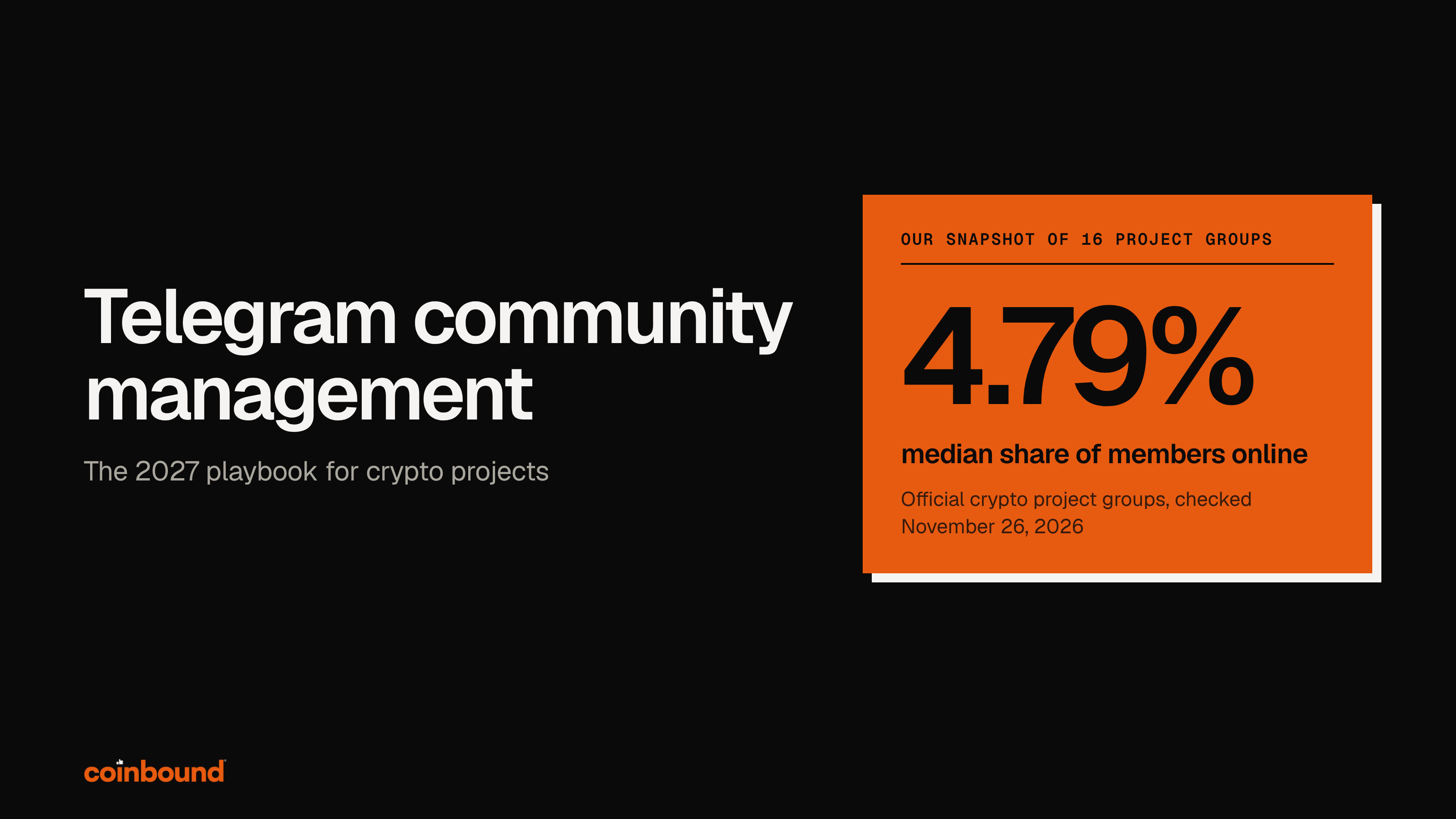
Here is a number most teams never look at. On November 26, 2026, we checked the official Telegram groups linked from 16 major crypto project homepages, and the median group had just 4.79% of its members online at that moment. The groups ranged from 345 to 68,594 members, and only one of the 16 showed more than 10% of members online.
Method: we fetched the homepages of 63 large crypto projects, kept the 25 that link a Telegram group, channel or bot in their served page code (one third-party link was excluded), and read the member and online counts on each public t.me preview page between 10:40 and 10:47am ET. The raw data is a single snapshot on a US holiday morning.
That gap between members and people actually in the room is what Telegram community management is really about. This guide covers how to set the group up, who should run it, the daily rhythm, launch-day playbooks and the numbers worth tracking in 2027.
What Telegram Community Management Covers
Most teams think of it as moderation. Moderation is one part of the job, but the full scope is wider.
A well-run project group handles six jobs at once:
- Moderation: removing spam, scam links, fake airdrops and off-topic floods before members see them.
- Support: answering wallet, bridge, staking and listing questions fast, or pointing people to the right doc.
- Impersonator defense: catching fake admin accounts and lookalike groups that target your members.
- Announcements: making sure product news, token events and incident updates reach members in the right order.
- Culture: setting the tone, rewarding helpful members and keeping the conversation about the project.
- Feedback: passing bug reports, feature requests and sentiment back to the core team every week.
If your group only does the first job, members will still feel ignored. If it does all six, the group turns into a real asset for retention and launches.
For the growth side (getting new members into the group in the first place), see our guide to crypto Telegram marketing. This post is about what happens after they join.
Group, Channel or Both?
Telegram gives you two main tools. A channel is one-way broadcast: only admins post, and members read. A group is a shared chat, and Telegram groups can hold up to 200,000 members, with admin tools built in.
In our sample, 7 of the 25 projects that link Telegram from their homepage link only a broadcast channel, with no open chat. Two more link only a bot. That is a real choice, not a mistake: a channel is far easier to run because there is nothing to moderate.
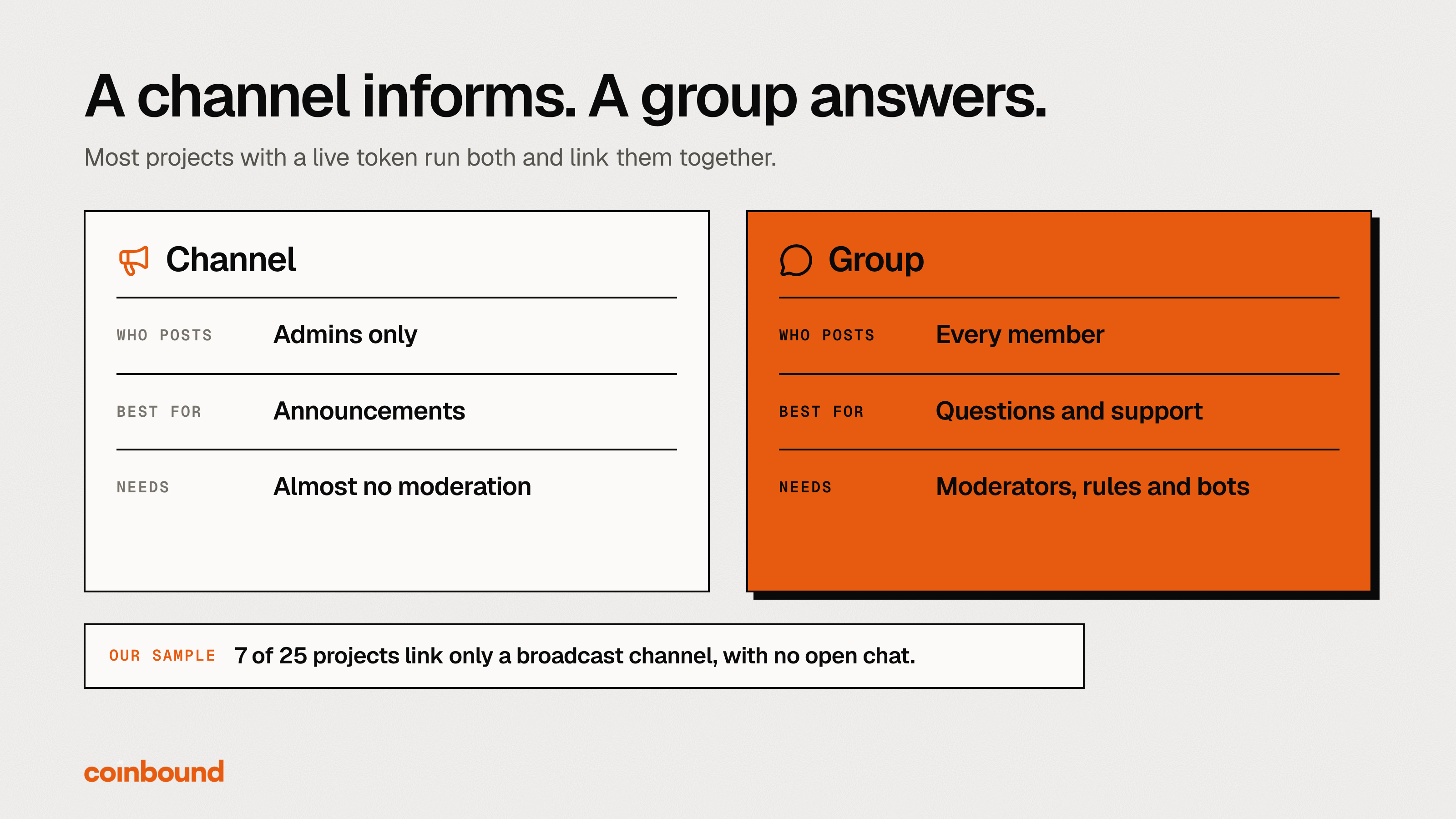
The trade-off is simple. A channel informs people, but it cannot answer them. Most projects with a live token or an active user base end up running both.
| Setup | Who can post | Best for | What it takes to run |
|---|---|---|---|
| Channel only | Admins | Announcements and updates | One or two admins, very little moderation |
| Group only | Every member | Questions, support and discussion | Moderators across time zones, rules and bots |
| Channel plus group | Admins in the channel, everyone in the group | Projects with a live token or active users | A community lead, moderators and a linked setup |
Our view: if people hold your token or use your product, they will ask questions somewhere. Better that they ask in a room you staff than in an unofficial group run by someone you have never met.
What Our Snapshot of 16 Groups Showed
The headline numbers from our check of 16 official project groups on November 26, 2026:
- Median online share: 4.79% of members.
- Lowest: 3.30% (Mantle, 64,965 members, 2,142 online).
- Highest: 13.04% (Synthetix Syndicate, 345 members, 45 online).
- Largest group: BNB Chain Community, 68,594 members, 2,788 online.
The pattern matters more than any single group. The biggest groups tended to have the lowest share of members online. Every large community carries a long tail of people who joined for one event and never left.
That changes how you should staff. Size the moderator team for the people actually in the room and the spikes around launches, not for the member count on the profile.
It also changes how you should read your own numbers. A 40,000-member group with 4% online is normal. A 40,000-member group where nobody asks a question for a day is a warning sign, whatever the online count says.
Who Runs the Group
A single community manager can run a small group. Once you pass a few thousand members or add a token, you need a small team with clear jobs.
Here is the structure we see work for most projects:
- Community lead. Owns the rules, the tone and the weekly report to the core team. Decides when to escalate.
- Moderators. Two to four people spread across time zones so the group is never unwatched for long. Each one has a written list of what to delete, what to warn and what to escalate.
- Technical responder. Someone from the product side who answers hard questions on a set schedule, so moderators are not guessing.
- Bots. A verification bot for new joins, a filter for links and keywords, and an FAQ bot for repeat questions. Combot and Rose are two common options.
Give every admin only the rights they need. Telegram lets you set each admin's rights in detail, and a moderator who can delete messages rarely needs the power to add new admins.
Use custom admin titles too. Telegram added custom titles for admins that show with every message, which helps members tell a real moderator from a lookalike.
Not sure whether to hire in-house? Our guide to hiring a crypto community manager covers the role in more depth.
Set Up the Group Before You Need It
The worst time to configure a group is during a launch. Lock in these settings while the room is still quiet.
- Turn on join requests. Telegram lets you require join requests for new members and screen them with a bot, which keeps out a large share of automated spam accounts.
- Enable Aggressive Anti-Spam. In large groups, this switch uses Telegram's full set of spam filters.
- Write a welcome message. Telegram can send welcome messages that only new members see. Use it for the rules, the official links and one line: admins will never message you first.
- Pin the essentials. Official website, contract addresses, docs and support links in one pinned message. Update it the same day anything changes.
- Set default permissions. Restrict links, files and forwards for regular members, or use a bot to hold them back for new joins.
- Add topics if the group is busy. Topics turn one group into separate threads, so support questions stop burying announcements.
- Keep slow mode ready. Slow mode limits each member to one message per interval you choose. It is the fastest way to calm a flooded chat.
Most of this takes an afternoon. It saves weeks of cleanup later.
Stop Scammers and Impersonators
Scams are the biggest threat to any crypto Telegram group. The usual playbook is simple: a fake account copies an admin's name and photo, then messages members privately with a "support" link or a fake claim page.
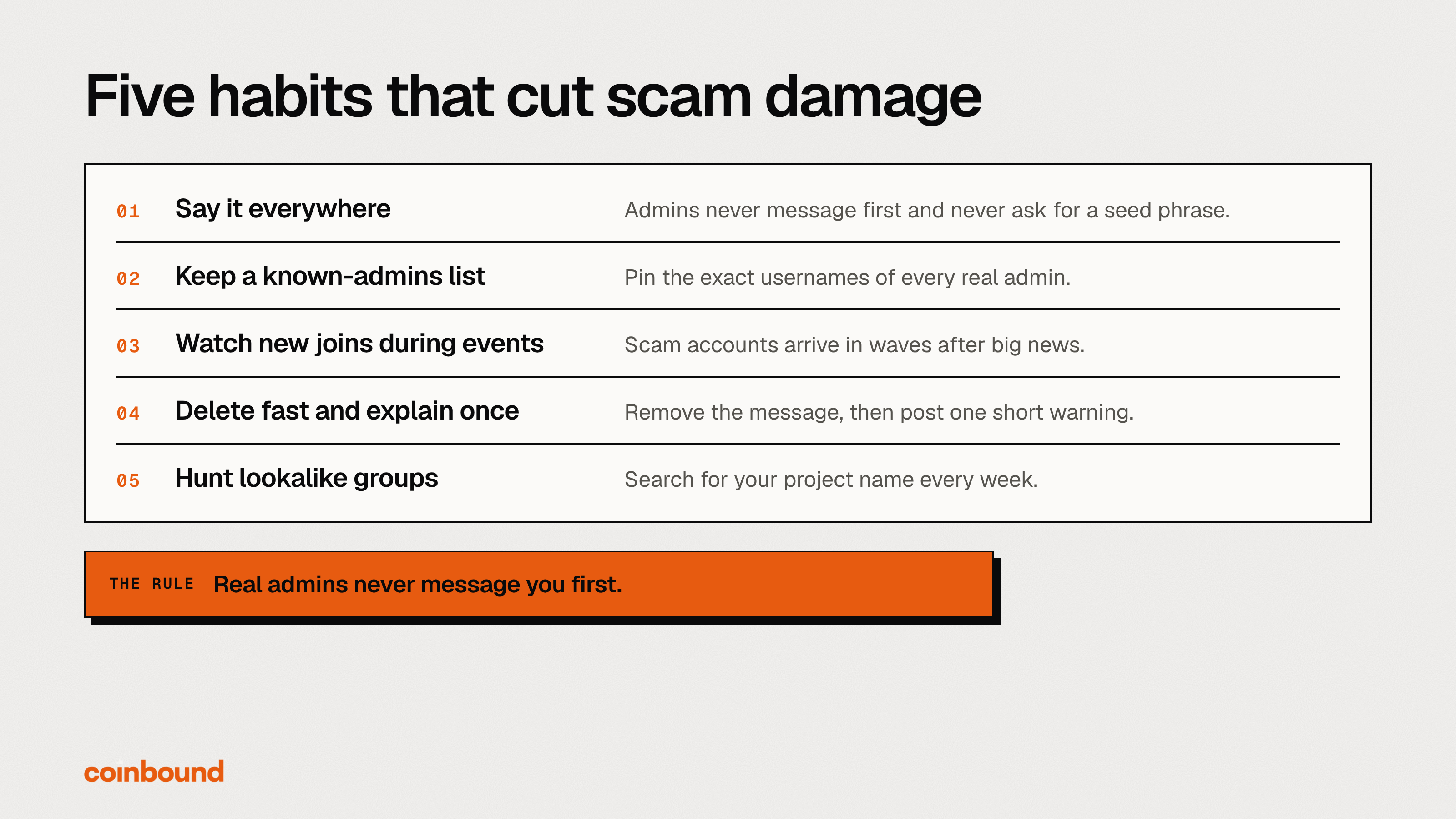
You cannot stop every attempt, but five habits cut most of the damage:
- Say it everywhere. Admins never message first, never ask for a seed phrase and never share claim links in private messages. Put that in the welcome message, the pinned post and the group description.
- Keep a known-admins list. Pin the exact usernames of every real admin and update it when the team changes.
- Watch new joins during events. Scam accounts arrive in waves right after big announcements.
- Delete fast and explain once. Remove the scam message, then post one short warning so members know what to ignore.
- Hunt lookalike groups. Search Telegram for your project name every week and report copycats.
Telegram's Recent Actions log shows what happened in the chat over the last 48 hours. Check it after every busy stretch to see what your filters missed.
The Daily and Weekly Rhythm
Good groups feel alive because someone is working them on a schedule, not only when things break.
Every day, moderators should:
- Clear spam and scam messages in each shift.
- Answer or route every unanswered question.
- Post one useful update, tip or link to keep the room moving.
- Flag repeated questions so the FAQ and pinned post get better.
Every week, the community lead should:
- Host one live session, such as an AMA with a team member. Our crypto AMA guide walks through the format.
- Send a short report to the core team: top questions, bugs, sentiment and anything that needs a reply from leadership.
- Recognize the most helpful members by name.
- Review moderator notes and update the rules if a new problem keeps showing up.
The rule we follow: every question gets a human reply or a pointer to the answer. A question that sits unanswered tells every reader that nobody is home.
Launch Days and Bad Days
Telegram traffic is spiky. A token generation event, an airdrop claim window or an exchange listing can bring more new members in a day than the group sees in a month. Our guide to what a TGE is in crypto covers that timeline in detail.
Before a big day:
- Double the moderator schedule for the first 48 hours.
- Turn on slow mode before the announcement, not after the flood.
- Pre-write answers for the ten questions you know will come.
- Post official links in one place and lock the pinned message.
Growth campaigns create the same spikes. When Coinbound ran a three-week Zealy sprint for a Solana DeFi platform, the case study reports "Telegram grew from 1,541 to 2,924 members" alongside 4,896 participants completing quests. A group nearly doubling in three weeks needs moderation that scales with it.
Bad days need a plan too. That same client faced a breach mid-campaign, and the team had to rebuild trust while the group was at its most nervous.
Your incident playbook should cover:
- Who speaks. One named team member posts official updates, so members are not reading five versions.
- Where updates live. The announcement channel first, then a pinned message in the group.
- What moderators say. A short holding line, a link to the latest update and no guessing about timelines.
- When to slow the room. Slow mode during the first hours keeps panic from drowning out the facts.
How to Tell If It Is Working
Member count is the number everyone shows off and the one that tells you the least. Track these instead.
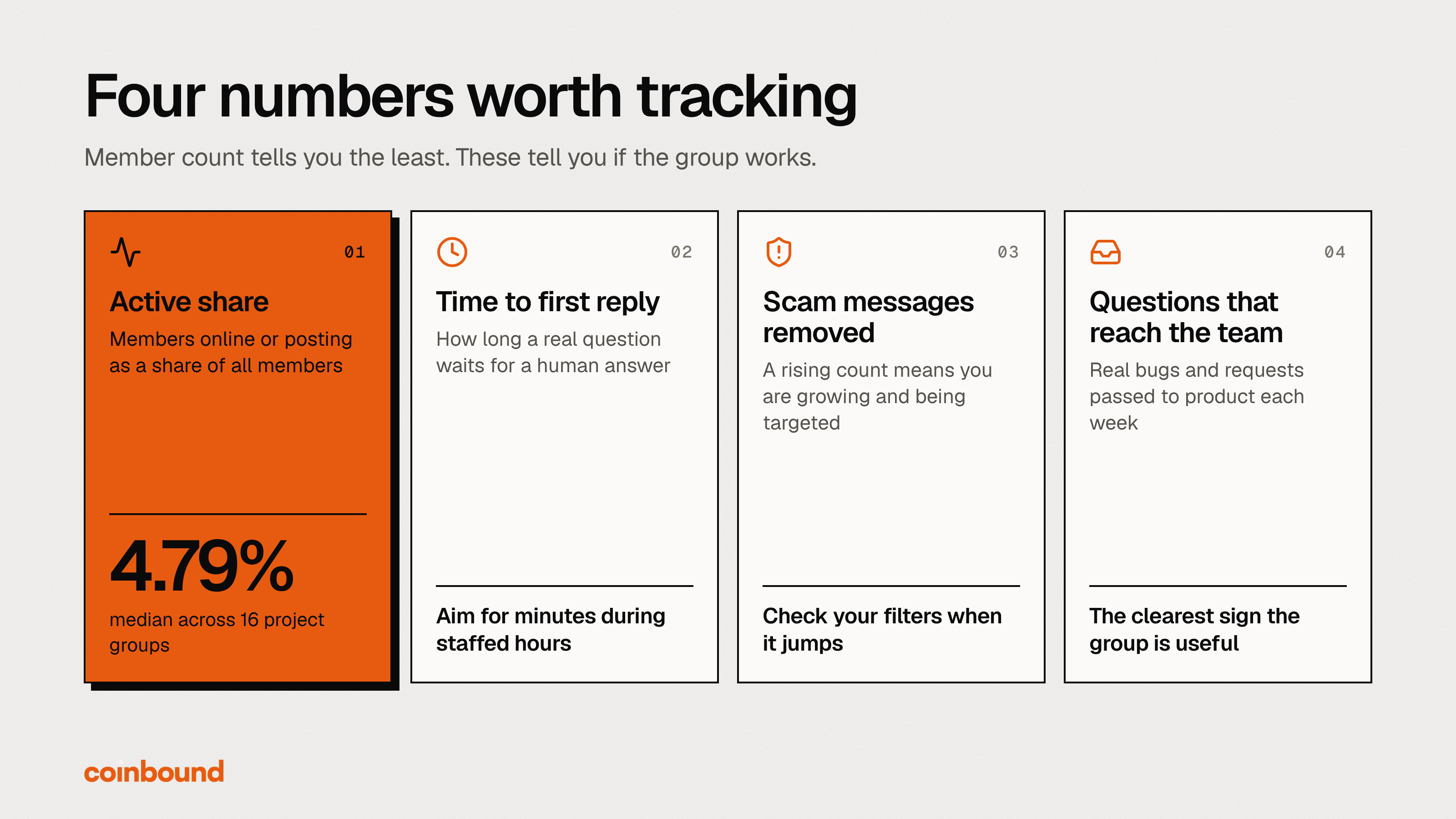
- Active share. Members online or posting as a share of total members. Our 16-group median of 4.79% is a useful benchmark for large groups.
- Time to first reply. How long a real question waits before a human answers it. Aim for minutes during staffed hours. Our own community team averages a question response time of under five minutes.
- Scam messages removed. A rising count usually means your group is growing and being targeted, so check your filters.
- Questions that reach the team. The number of real bugs and requests the community lead passes to product each week.
Review these monthly. If active share drops while member count rises, the group is collecting tourists, and your content or support needs work.
Common Mistakes to Avoid
Most failing groups make the same few errors:
- Running it with no one awake. A group that goes quiet for eight hours every night is open season for scammers.
- Letting price talk take over. Set a rule early on how much price chat you allow, and point it to a separate topic.
- Buying members. Fake members inflate the count, crush your active share and make the group look abandoned to real visitors.
- Too many admins with full rights. Every extra account with full control is another account that can be taken over.
- Answering only easy questions. Hard technical questions need a technical responder, or people stop asking.
When to Bring in Help
Many teams run Telegram in-house until a launch or token event makes it a full-time job. That is usually the moment to add outside support.
Coinbound has worked with 900+ crypto and Web3 clients, and our community management team handles setup, moderation and events for Telegram and Discord communities. We often pair it with KOL marketing, since creator campaigns are what fill the group in the first place.
Frequently Asked Questions
What is Telegram community management?
Telegram community management is the work of running an official Telegram group for a project or brand. It covers moderation, member support, spam and scam defense, announcements and reporting feedback to the core team.
How many moderators does a crypto Telegram group need?
A small group can run with one community manager and good bots. Once a group passes a few thousand members or a token goes live, plan for two to four moderators across time zones plus a technical responder.
Should a crypto project use a Telegram group or a channel?
Use a channel for one-way announcements and a group for conversation and support. Most projects with a live token or active users run both and link them together.
What bots help manage a Telegram group?
Most teams use a verification bot for new members, a filter bot for links and keywords, and an FAQ bot for repeat questions. Combot and Rose are two widely used group management bots.
How do you stop scammers in a crypto Telegram group?
Turn on join requests and Aggressive Anti-Spam, block links from new members, pin a list of real admin usernames and repeat one rule everywhere: admins never message first.
What is a good engagement rate for a Telegram group?
In our November 2026 snapshot of 16 official crypto project groups, the median group had 4.79% of members online. Smaller groups tended to run higher. Track the trend in your own group rather than chasing one number.
Build a Telegram Group Worth Joining
Telegram community management is not glamorous work, but it decides whether your group is an asset or a liability. Set it up before you need it, staff it for real traffic and measure activity instead of headcount.
If you want a team that has done this through launches, airdrops and hard weeks, talk to Coinbound about community management, or browse our case studies to see how past campaigns played out.